Chatham House
What Brexit Satisfies the Democratic Will of the People?

- Title
- What Brexit Satisfies the Democratic Will of the People?
- Runtime
- 1:05:35
- Date posted
- 7 years ago
- Description
- As the date for the UK’s departure from the European Union draws near, the panel reflects on how the reality of the Brexit negotiations has compared to the rhetoric of the referendum campaign.
Are the difficulties Theresa May’s government has had in negotiating a satisfactory withdrawal agreement with the European Union an inevitable consequence of a mandate to deliver a narrowly, or ill-defined, concept?
Or could more have been done to achieve a consensus over what Brexit means much sooner after the referendum?
Given the diverse reasons people voted to leave the EU, and the range of interpretations offered by politicians as to what ‘the people’ voted for in June 2016, are there any agreed tenets of Brexit that could guide the UK government in enacting the ‘democratic will of the people’?
And as Brexiteers reflect on the last two and a half years of public and political discourse, how has the reality of Brexit tallied w...

- Title
- American Diplomacy: Past, Present and Future
- Runtime
- 59:49
- Date posted
- 7 years ago
- Description
- Since coming to power in January 2017, US President Donald Trump has been accused of changing the rules of American diplomacy. From his decisions to withdraw from the Iran nuclear deal to ending US participation in the Paris agreement on climate change, he has consistently advocated for ‘America First’ in US foreign relations.
On the one hand, commentators have contended that such a policy has come at the expense of long-standing diplomatic ties. On the other hand, Trump’s supporters have praised the president for attempting to tackle difficult foreign diplomacy challenges, such as the denuclearization of North Korea, which have proved intractable in the face of conventional diplomatic efforts.
Drawing on his experience as an American diplomat, William Burns provides insights into his profession and makes the case for American diplomacy in an increasingly volatile world.
Reflecting on some of the most consequential diplomatic episodes of h...
- Title
- The State of Brexit on ‘Brexit Day’
- Runtime
- 1:13:41
- Date posted
- 7 years ago
- Description
- ‘We will be leaving the European Union on the 29th of March 2019’. Prior to asking the EU for an extension to the end of March deadline, Theresa May had made this assertion in public over one hundred times since the UK, in 2017, gave notification of its intention to leave under Article 50 of the Treaty on European Union. Exactly two years on from that notification, the panel reflects on how events have unfolded and what the future holds for Brexit, the United Kingdom and Europe.
Was it inevitable that reaching agreement on withdrawal, both between the UK and the EU and within the UK parliament, would prove so difficult? What lessons can the UK draw from the last two years that might be useful in future negotiations with the EU? What does the EU want from its long-term relationship with the UK and what might that relationship look like in five years’ time?

- Title
- Ukraine Elections: Nataliya Gumenyuk, Hromadske TV
- Runtime
- 4:17
- Date posted
- 7 years ago
- Description
- Nataliya Gumenyuk sits down with the Ukraine Forum to discuss the key issues in the 2019 presidential elections.
The conversation focuses on the integrity of the electoral process, economic agenda of the key candidates and the implications for the conflict in the East of Ukraine.
The Ukraine Forum brings together a dynamic group of stakeholders, including politicians, practitioners, civil society leaders, academics and journalists to examine the political situation in Ukraine.
Video produced in partnership with Ukrainian Prism.
Watch more Ukraine Elections expert analysis on the Chatham House Ukraine Forum playlist:
https://www.youtube.com/playlist?list=PLy9ppGFZeRr7OUQ6CJBPrUb1xCbrgFX70

- Title
- Spotlight on Ukrainian Elections
- Runtime
- 0:54
- Date posted
- 7 years ago
- Description
- The Chatham House Ukraine Forum asks leading independent Ukrainian experts about the integrity of the electoral process, the economic agendas of the key candidates and the implications for the conflict in the east of Ukraine.
Watch all videos on the Chatham House Ukraine Forum playlist here: https://www.youtube.com/playlist?list=PLy9ppGFZeRr7OUQ6CJBPrUb1xCbrgFX70
Videos produced in partnership with Ukrainian Prism, funded by Black Sea Trust, The German Marshall Fund of the United States.

- Title
- Ukraine Elections: Volodymyr Yermolenko, Internews Ukraine
- Runtime
- 4:32
- Date posted
- 7 years ago
- Description
- Volodymyr Yermolenko sits down with the Ukraine Forum to discuss the key issues in the 2019 presidential elections.
The conversation focuses on the integrity of the electoral process, economic agenda of the key candidates and the implications for the conflict in the East of Ukraine.
The Ukraine Forum brings together a dynamic group of stakeholders, including politicians, practitioners, civil society leaders, academics and journalists to examine the political situation in Ukraine.
Video produced in partnership with Ukrainian Prism.
Watch more Ukraine Elections expert analysis on the Chatham House Ukraine Forum playlist:
https://www.youtube.com/playlist?list=PLy9ppGFZeRr7OUQ6CJBPrUb1xCbrgFX70

- Title
- Ukraine Elections: Oleksiy Haran, Democratic Initiatives Foundation
- Runtime
- 2:33
- Date posted
- 7 years ago
- Description
- Oleksiy Haran sits down with the Ukraine Forum to discuss the key issues in the 2019 presidential elections.
The conversation focuses on the integrity of the electoral process, economic agenda of the key candidates and the implications for the conflict in the East of Ukraine.
The Ukraine Forum brings together a dynamic group of stakeholders, including politicians, practitioners, civil society leaders, academics and journalists to examine the political situation in Ukraine.
Video produced in partnership with Ukrainian Prism.
Watch more Ukraine Elections expert analysis on the Chatham House Ukraine Forum playlist:
https://www.youtube.com/playlist?list=PLy9ppGFZeRr7OUQ6CJBPrUb1xCbrgFX70

- Title
- Ukraine Elections: Viktor Andrusiv, Ukrainian Institute for the Future
- Runtime
- 3:39
- Date posted
- 7 years ago
- Description
- Viktor Andrusiv sits down with the Ukraine Forum to discuss the key issues in the 2019 presidential elections.
The conversation focuses on the integrity of the electoral process, economic agenda of the key candidates and the implications for the conflict in the East of Ukraine.
The Ukraine Forum brings together a dynamic group of stakeholders, including politicians, practitioners, civil society leaders, academics and journalists to examine the political situation in Ukraine.
Video produced in partnership with Ukrainian Prism.
Watch more Ukraine Elections expert analysis on the Chatham House Ukraine Forum playlist:
https://www.youtube.com/playlist?list=PLy9ppGFZeRr7OUQ6CJBPrUb1xCbrgFX70

- Title
- Ukraine Elections: Maria Levonova, CENTRE UA
- Runtime
- 5:11
- Date posted
- 7 years ago
- Description
- Maria Levonova sits down with the Ukraine Forum to discuss the key issues in the 2019 presidential elections.
The conversation focuses on the integrity of the electoral process, economic agenda of the key candidates and the implications for the conflict in the East of Ukraine.
The Ukraine Forum brings together a dynamic group of stakeholders, including politicians, practitioners, civil society leaders, academics and journalists to examine the political situation in Ukraine.
Video produced in partnership with Ukrainian Prism.
Watch more Ukraine Elections expert analysis on the Chatham House Ukraine Forum playlist:
https://www.youtube.com/playlist?list=PLy9ppGFZeRr7OUQ6CJBPrUb1xCbrgFX70

- Title
- Britain in the Great War
- Runtime
- 36:16
- Date posted
- 7 years ago
- Description
- Jeremy Paxman discusses Britain’s role in the First World War and the day-to-day experience of those involved, from politicians and generals to factory workers and soldiers on the front lines.
He considers what shaped the mood and morale of the country from 1914-18 and explains how life and identity in Britain were changed as a result of the war.

- Title
- Operation Decisive Storm: Analysing Four Years of Conflict in Yemen
- Runtime
- 59:36
- Date posted
- 7 years ago
- Description
- Are the Houthis weakened militarily or politically? How has this new regional order shaped the region?
What are the political, economic and security consequences of this war in Yemen and why has the Stockholm agreement not yet been implemented three months after its creation?

- Title
- Brexit: In Search of A Solution - The Common Market 2.0 Option
- Runtime
- 1:16:31
- Date posted
- 7 years ago
- Description
- With Prime Minister Theresa May’s EU withdrawal agreement again defeated by the UK parliament and a majority of MPs opposed to 'No Deal', parliament appears to know what it doesn’t want but not what it does.
Against this background, what sort of deal could win a majority in the House of Commons and form the basis of a national compromise?
A cross party panel of MPs present their way forward: the so-called ‘Common Market 2.0’ proposal (also known as ‘Norway Plus’).
This option involves accepting the current withdrawal agreement but renegotiating the political declaration, committing the UK to join the European Free Trade Association (EFTA).
As members of EFTA, the UK would maintain full participation in the single market via the European Economic Area but would leave the EU’s political institutions, thus, it is argued, respecting the result of the 2016 referendum while protecting the economy.
Could such a f...

- Title
- The Future of Syria: Session 4 - Beyond Stabilization and Towards Inclusivity
- Runtime
- 1:29:58
- Date posted
- 7 years ago
- Description
- This session discusses current stabilization negotiations that focus on power redistribution among dominant parties. It also highlights the role of external actors in any potential agreement and how they can support Syrian civil society to achieve sustainable peace.
The Syrian conflict’s continuation reveals the level of complexity in finding a road map to achieving sustainable peace, while Syria rapidly loses its human, social, physical, financial and natural assets.
Yet the international community’s efforts focus mainly on the balancing of power between fighting parties and on short-term stabilization instead of negotiating an inclusive peace agreement.
This conference brings together policymakers, experts, academics and civil society leaders to identify the main institutional and socio-economic challenges to stabilization in Syria, and to offer policy recommendations in support of an inclusive peacebuilding process.

- Title
- The Future of Syria: Session 3 - Challenges for Social Cohesion
- Runtime
- 1:26:29
- Date posted
- 7 years ago
- Description
- The panel discusses the main drivers of deterioration in social cohesion and social capital, and explores mechanisms used by different actors to increase polarization in Syrian society.
Speakers propose policy options to restore Syria’s social capital and to create a hospitable environment for returnees.
The Syrian conflict’s continuation reveals the level of complexity in finding a road map to achieving sustainable peace, while Syria rapidly loses its human, social, physical, financial and natural assets.
Yet the international community’s efforts focus mainly on the balancing of power between fighting parties and on short-term stabilization instead of negotiating an inclusive peace agreement.
This conference brings together policymakers, experts, academics and civil society leaders to identify the main institutional and socio-economic challenges to stabilization in Syria, and to offer policy recommendations in support of an in...

- Title
- The Future of Syria: Session 2 - The Politics of Reconstruction
- Runtime
- 1:29:09
- Date posted
- 7 years ago
- Description
- Exploring the current political context and funding mechanisms for reconstruction, and the social, economic and demographic implications for Syrians inside and outside of the country.
The panel offers policy recommendations in support of the formation of an inclusive reconstruction process.
The Syrian conflict’s continuation reveals the level of complexity in finding a road map to achieving sustainable peace, while Syria rapidly loses its human, social, physical, financial and natural assets.
Yet the international community’s efforts focus mainly on the balancing of power between fighting parties and on short-term stabilization instead of negotiating an inclusive peace agreement.
This conference brings together policymakers, experts, academics and civil society leaders to identify the main institutional and socio-economic challenges to stabilization in Syria, and to offer policy recommendations in support of an inclusive peacebu...

- Title
- The Future of Syria: Session 1 - Conflict Economy Dynamics
- Runtime
- 1:31:14
- Date posted
- 7 years ago
- Description
- The panel discusses the conflict’s impact on different economic sectors and offers examples of coping strategies utilised by local communities.
The session focuses on the competition between different external actors and how they cooperate with internal ones to benefit from the Syrian conflict economy.
Speakers also discuss the effect of the conflict economy on the restoration of state functions.
The Syrian conflict’s continuation reveals the level of complexity in finding a road map to achieving sustainable peace, while Syria rapidly loses its human, social, physical, financial and natural assets.
Yet the international community’s efforts focus mainly on the balancing of power between fighting parties and on short-term stabilization instead of negotiating an inclusive peace agreement.
This conference brings together policymakers, experts, academics and civil society leaders to identify the main institutional and s...
- Title
- Yemen: Local Pockets of Stability Can Build Peace
- Runtime
- 2:52
- Date posted
- 7 years ago
- Description
- Nadwa Al-Dawsari says the main challenge to creating long-lasting peace is a misunderstanding of what is driving the conflict.
She says observers like to see this as a regional conflict involving Saudi Arabia, or ISIS, whereas the reality is it is very local to Yemen itself based on internal dynamics and long-standing grievances.
Nadwa argues that there is a level of order at a local level that outsiders do not see, and there is potential to build on these pockets of stability and take that to a national level.
She believes the conflict may go for a long time and solutions may not be found for up to a decade, and so it is important to invest in those areas of stability to create more opportunities to develop an overall peace.

- Title
- Iraq: How to Rebuild the State
- Runtime
- 1:00
- Date posted
- 7 years ago
- Description
- He says the international community has the necessary finance available but that there is a lack of confidence in how it will be spent.
Restoring this confidence is dependent on the new government passing laws to ensure better transparency, which will make Iraq an attractive investment opportunity internationally and also create stability in the country.

- Title
- Iraq: Protests Driven By Corruption and Unemployment
- Runtime
- 1:19
- Date posted
- 7 years ago
- Description
- He argues that all other problems facing Iraqis, such as poor public services, electricity and water are all rooted in the two main issues of corruption and unemployment, and that the people know this.
Munqith says that without real action, protests could not only continue but increase, especially in the south around Basra.

- Title
- Yemen: Why the South Must Be Heard
- Runtime
- 1:34
- Date posted
- 7 years ago
- Description
- Ghaidaa describes how the conflict situation is not purely as simple as being between Al-Houthi and the government, but is in fact a multi-layered situation.
She says even if the fighting were to end, to achieve a long-lasting peace would require engagement with the south of the country and to ensure their needs are taken into account.
- Title
- The Militarization of the Black Sea After the Annexation of Crimea
- Runtime
- 56:54
- Date posted
- 7 years ago
- Description
- The panel explores the impact of new Russian dominance in the Black Sea region on the power dynamics between Russia, Ukraine and NATO.
In the five years since the illegal annexation of Crimea, Russia is said to have turned the region into a ‘military fortress’ by increasing military personnel on the ground and developing a multi-layered air, naval and coastal defence system.
The annexation has also meant that Russia now shares a direct maritime border with Bulgaria and Romania - two members of the Atlantic Alliance - in the Black Sea.
Moreover, the Kremlin has been accused of seeking to establish control over the neighbouring Sea of Azov and close it to Ukrainian navigation.
Most recently, it built a bridge over the Kerch straight, a waterway connecting Russia to Crimea.
How can Ukraine defend its territorial integrity from further encroachments? What does Russian militarization of the Black Sea mean for wider Euro...
- Title
- Ukraine Elections: Oleksandr Sushko, Renaissance Foundation
- Runtime
- 3:02
- Date posted
- 7 years ago
- Description
- Oleksandr sits down with the Ukraine Forum to discuss the key issues in the 2019 presidential elections.
The conversation focuses on the integrity of the electoral process, economic agenda of the key candidates and the implications for the conflict in the East of Ukraine.
The Ukraine Forum brings together a dynamic group of stakeholders, including politicians, practitioners, civil society leaders, academics and journalists to examine the political situation in Ukraine.
Video produced in partnership with Ukrainian Prism.
Watch more Ukraine Elections expert analysis on the Chatham House Ukraine Forum playlist:
https://www.youtube.com/playlist?list=PLy9ppGFZeRr7OUQ6CJBPrUb1xCbrgFX70

- Title
- Chatham House Primer: ‘Leaving on WTO Terms’
- Runtime
- 53:18
- Date posted
- 7 years ago
- Description
- Peter Ungphakorn, who spent 18 years of his career in the WTO Secretariat, explains the nature of WTO agreements and attempts to unpack their relevance within the context of Brexit.
During the last few years of public and parliamentary debate around Brexit, there has been much discussion of a no-deal scenario and the United Kingdom simply leaving the European Union ‘on World Trade Organization (WTO) terms’ or ‘under WTO rules’.
In reality, this phraseology is confusing. At its most basic, it is a reference to the nature of the future trading relationship between the UK and the EU absent any agreement on such a relationship. But, in practice, the ideas that underlie the simple expression are much more complex and nuanced. What exactly are ‘WTO terms’ and to what sort of 'trade' do they apply?
Peter Ungphakorn, who spent 18 years of his career in the WTO Secretariat, will try to clarify some of the confusion in this area, explaining the ...

- Title
- Brexit and the Future of the UK–EU Relationship
- Runtime
- 3:40
- Date posted
- 7 years ago
- Description
- In the wake of the second rejection of British Prime Minister Theresa May’s Brexit deal in the House of Commons, Robin Niblett reflects on where the two sides go from here.
He discusses the likelihood of a no-deal and a second referendum, and whether the current Brexit deal still has a future, as well as the appetite on the EU side for further negotiation and the future of its relationship with the UK.
He also outlines why further debate and argument within the UK parliament could be hugely problematic and simply create more uncertainty.

- Title
- Iraq and ISIS: Why The Threat is Never Over
- Runtime
- 2:44
- Date posted
- 7 years ago
- Description
- Renad Mansour, a research fellow in the Middle East and North Africa Programme at Chatham House, discusses the new government and the current state of ISIS in Iraq.
He says that the first 100 days of the new premiership in the country has seen little progress, and that Iraqis are already preparing to demonstrate against the new regime.
Corruption is the issue driving this, he argues, which citizens equate with terrorist organizations. ISIS is a dynamic organization and has gone underground but have the roots which led to its power been addressed?
Renad says proper representation in the country's political process is key to challenging groups such as ISIS, and that previous cycles of violence show another uprising could easily happen if these issues are not addressed.

- Title
- Icebreaker Lecture: China’s Financial Sector – Reform and Opening Up
- Runtime
- 1:08:34
- Date posted
- 7 years ago
- Description
- Former governor of the People’s Bank of China, Zhou Xiaochuan, discusses current developments in China’s financial sector and the prospects of further reform and international cooperation.
This event is co-organised with the 48 Group Club and the China Chamber of Commerce in the UK.

- Title
- Unintended Consequences? Foreign Intervention in the Middle East
- Runtime
- 1:00:18
- Date posted
- 7 years ago
- Description
- On 20 March 2003, American missiles first hit Baghdad, signalling the start of a US-led campaign to overthrow Saddam Hussein. 16 years later, Iraq has witnessed perpetual conflict, which reached its nadir in 2014 when ISIS militants captured one third of the country.
The breakdown of the unitary state throughout the region has ushered in an era of instability and violence.
This panel critically assesses the degree to which enduring instability in Iraq and the broader region can be seen as an unintended consequence of foreign intervention.
How can we explain the link, if any, between Western intervention and cycles of violence in the Middle East? Could this be having a knock-on effect on the US and Europe?
If so, to what extent might the Iraq war, the so-called Arab Spring, the refugee crisis in Europe and the subsequent rise of populism in the West be interconnected?

- Title
- Ukraine Elections: Yevhen Hlibovytsky, Nestor Group
- Runtime
- 3:45
- Date posted
- 7 years ago
- Description
- Yevhen sits down with the Ukraine Forum to discuss the key issues in the 2019 presidential elections.
The conversation focuses on the integrity of the electoral process, economic agenda of the key candidates and the implications for the conflict in the East of Ukraine.
The Ukraine Forum brings together a dynamic group of stakeholders, including politicians, practitioners, civil society leaders, academics and journalists to examine the political situation in Ukraine.
Video produced in partnership with Ukrainian Prism.
Watch more Ukraine Elections expert analysis on the Chatham House Ukraine Forum playlist:
https://www.youtube.com/playlist?list=PLy9ppGFZeRr7OUQ6CJBPrUb1xCbrgFX70

- Title
- Ukraine Elections: Hanna Shelest, Ukrainian Prism
- Runtime
- 6:30
- Date posted
- 7 years ago
- Description
- Hanna sits down with the Ukraine Forum to discuss the key issues in the 2019 presidential elections.
The conversation focuses on the integrity of the electoral process, economic agenda of the key candidates and the implications for the conflict in the East of Ukraine.
The Ukraine Forum brings together a dynamic group of stakeholders, including politicians, practitioners, civil society leaders, academics and journalists to examine the political situation in Ukraine.
Video produced in partnership with Ukrainian Prism.
Watch more Ukraine Elections expert analysis on the Chatham House Ukraine Forum playlist:
https://www.youtube.com/playlist?list=PLy9ppGFZeRr7OUQ6CJBPrUb1xCbrgFX70

- Title
- Projected Economic Growth Inside Syria (2010-2030)
- Runtime
- 0:46
- Date posted
- 7 years ago
- Description
- This animated graph illustrates Syria’s GDP in billions of Syrian Pounds (SYP) between 2010 and 2030, and the results show the catastrophic long term impact of the crisis in Syria regardless how much economic growth there will be.
Based on a projection made by The Economist* of 9.9% economic growth in Syria for 2019, Syria would only regain its 2010 GDP level by 2030 if this projected trend continued.
As a result, this would mean the gap between the actual GDP and the counterfactual GDP (what GDP would be if the conflict did not happen) is projected to be 250% of Syria’s total GDP in 2010.
The chart shows:
- Crisis GDP estimations. Based on the Syrian Center for Policy Research (SCPR) report for the years 2010 till 2015 and on the Economic and Social Commission for Western Asia (ESCWA) report for 2016 and 2017; whereas the crisis GDP for 2018 and 2019 are based on The Economist’s projections; the GDP growth rate is assumed t...
- Title
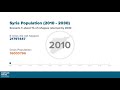
- Population Inside Syria (2010-2030) - Scenario 1
- Runtime
- 1:09
- Date posted
- 7 years ago
- Description
- This scenario shows that the population of Syria by 2030 is estimated to be 32% lower, compared to the expected level if the crisis had not happened.
This takes into account the numbers of refugees, migrants, and changes in the natural population growth rate, and projects the total number of refugees to be around 6.8 million at 2030, with no more than 65,000 having returned.
Sources for the data
- Population inside Syria during crisis between 2010 and 2016: based on Syrian Center for Policy Research (SCPR) surveys and calculations
- Refugees in 2018: UNHCR; and refugees (2019-2030) based on scenarios and author’s projections using MortPak to estimate population growth rate among refugees.
- Population projection crisis and counterfactual (author’s calculations using MortPak with the following inputs: age specific fertility rate (in 2010 based on SCPR), population distribution by age group, migration pattern, life expectancy (SCPR). <...

- Title
- Population Inside Syria (2010-2030) - Scenario 2
- Runtime
- 1:09
- Date posted
- 7 years ago
- Description
- This scenario shows that the population of Syria by 2030 is estimated to be 26% lower, compared to the expected level if the crisis had not happened.
This takes into account the numbers of refugees, migrants, and changes in the natural population growth rate, and projects the total number of refugees to be around 4.4 million at 2030, with about 2.4 million having returned.
Sources for the data
- Population inside Syria during crisis between 2010 and 2016: based on Syrian Center for Policy Research (SCPR) surveys and calculations
- Refugees in 2018: UNHCR; and refugees (2019-2030) based on scenarios and author’s projections using MortPak to estimate population growth rate among refugees.
- Population projection crisis and counterfactual (author’s calculations using MortPak with the following inputs: age specific fertility rate (in 2010 based on SCPR), population distribution by age group, migration pattern, life expectancy (SCPR).

- Title
- Population Inside Syria (2010-2030) - Scenario 3
- Runtime
- 1:09
- Date posted
- 7 years ago
- Description
- This scenario shows that the population of Syria by 2030 is estimated to be 21% lower, compared to the expected level if the crisis had not happened.
This takes into account the numbers of refugees, migrants, and changes in the natural population growth rate, and projects the total number of refugees to be around 2.7 million at 2030, with about 4 million having returned.
Sources for the data
- Population inside Syria during crisis between 2010 and 2016: based on Syrian Center for Policy Research (SCPR) surveys and calculations
- Refugees in 2018: UNHCR; and refugees (2019-2030) based on scenarios and author’s projections using MortPak to estimate population growth rate among refugees.
- Population projection crisis and counterfactual (author’s calculations using MortPak with the following inputs: age specific fertility rate (in 2010 based on SCPR), population distribution by age group, migration pattern, life expectancy (SCPR).

- Title
- Stacey Abrams: Democracy and the Politics of Identity (Short Clip)
- Runtime
- 6:10
- Date posted
- 7 years ago
- Description
- Watch the full event video
https://youtu.be/5zr_DqOLJYA
Building on some of the themes outlined in her official response on behalf of the Democratic Party to President Donald Trump’s State of the Union address in February, Stacey Abrams makes the case that identity politics are crucial to the health of any democracy.
Prominent commentators, such as Francis Fukuyama and Mark Lilla, have called for an end to an era of ‘identity liberalism’, claiming that an over-concentration on these issues focuses minds on human differences rather than human commonalities.
Abrams, by contrast, argues it is disingenuous and overly reductive to ignore or attempt to obfuscate the complex links between notions of race, gender, and socio-economic position.
She asserts that giving people a voice, in part through the identities that dominant groups have historically used to oppress them, allows previously silenced, marginalized groups to make th...

- Title
- Stacey Abrams: Democracy and the Politics of Identity (Full Event)
- Runtime
- 1:04:22
- Date posted
- 7 years ago
- Description
- Watch a shorter clip from this speech
https://youtu.be/whqV_WXA0kY
Building on some of the themes outlined in her official response on behalf of the Democratic Party to President Donald Trump’s State of the Union address in February, Stacey Abrams makes the case that identity politics are crucial to the health of any democracy.
Prominent commentators, such as Francis Fukuyama and Mark Lilla, have called for an end to an era of ‘identity liberalism’, claiming that an over-concentration on these issues focuses minds on human differences rather than human commonalities.
Abrams, by contrast, argues it is disingenuous and overly reductive to ignore or attempt to obfuscate the complex links between notions of race, gender, and socio-economic position.
She asserts that giving people a voice, in part through the identities that dominant groups have historically used to oppress them, allows previously silenced, marginalized groups...

- Title
- What Does the Future Hold for Saudi Arabia's Economy?
- Runtime
- 5:00
- Date posted
- 7 years ago
- Description
- Ellen Wald discusses why economic diversification in Saudi Arabia tends to be top-down, and the impact of the government flooding the market with its own investment money.
Ellen argues this level of state control can limit the potential for new business start-ups, and that a lot of the recent big deals remain in industries such as petro-chemicals and mining.
With the current risk of oil prices rising, does this mean the US may ask Saudi Arabia to increase oil production? And if so, how would Saudi Arabia respond given its growing interests in its relationship with Russia?

- Title
- The Geopolitical Positioning of Europe
- Runtime
- 1:08:29
- Date posted
- 7 years ago
- Description
- The president of Slovenia discusses the challenges the European continent is facing as well as his vision for the global positioning and future of Europe.
Focusing on both the Western Balkan region as well as the wider EU, he makes the case for strengthening the rule of law and democracy and emphasize the importance of reconciliation, peace and compromise.
As the European Union reorganizes in the wake of Brexit, the president further considers new challenges and the need for effective multilateralism, among the EU block and beyond, in order to address them.

- Title
- Moscow Rules: What Drives Russia to Confront the West?
- Runtime
- 1:00:37
- Date posted
- 7 years ago
- Description
- At this event, Keir Giles presents key findings from his book Moscow Rules: What Drives Russia to Confront the West? and addresses a number of critically important questions for dealing with Russia.
Developing a better relationship with Russia has to be tempered with Moscow's apparent view of the West as a threat. This view, and the Russian actions that result from it, can be difficult for people in the West to understand.
He argues that understanding - or at least accepting - this worldview forms an essential starting point for managing relations with Russia without lurching from crisis to crisis.
Why does Russia misread Western intentions so consistently? How can past experience of both successful and unsuccessful engagement guide future attempts?
And can recognizing the reality of confrontation with Russia help the West manage the challenge from Moscow effectively while avoiding the risk of a deeper conflict?
- Title
- The Legacy of Faleh Abdul Jabar (1946-2018)
- Runtime
- 1:01:51
- Date posted
- 7 years ago
- Description
- Born in Baghdad in 1946, Jabar’s long career in intellectual and public life was marked by several fundamental texts for the study of Iraq, including the Shiite Movement in Iraq, Post-Marxism and the Middle East, Ayatollahs, Sufis and Ideologues: State, Religion and Social Movements in Iraq, and Tribes and Power: Nationalism and Ethnicity in the Middle East.

- Title
- Rethinking the Governance of Solar Geoengineering
- Runtime
- 57:55
- Date posted
- 7 years ago
- Description
- In October 2018, The Intergovernmental Panel on Climate Change issued a special report highlighting the unprecedented scale and pace of action now required to reduce global greenhouse gas emissions if the world is to limit global warming to 1.5ºC.
With scientists portending the possible extinction of species, increased extreme weather conditions and the decline of agricultural productivity across swaths of the globe, governments and scientists are under increasing pressure to explore new technologies that might mitigate the risks of climate change.
One such development is solar geoengineering which seeks to lower the Earth’s temperatures by reflecting sunlight back into space or allowing more infrared radiation to escape.
However, the risks, trade-offs and potential of the technology are still poorly understood. At what stage of development is this technology? Who should make the decision to set the global thermostat, how and under what condi...
- Title
- Iran's Revolution at 40
- Runtime
- 17:56
- Date posted
- 7 years ago
- Description
- On February 11 2019, the Islamic Republic of Iran marked the 40th anniversary of the overthrow of its monarchy after a popular revolution.
Iran has faced a variety of challenges over the past 40 years and will be marking this anniversary in an atmosphere of renewed sanctions and tensions with the United States, intermittent protests and internal economic challenges.
What is next for Iran going forward and how has its domestic and international outlook shifted over the last four decades?
Will political and economic corruption, often discussed as institutionalized in Iran's governing systems remain prevalent?
What effect will continued sanctions have on both domestic unrest and the Iranian economy? And how does Iran define its own role in the Middle East?

- Title
- Meat but not as we know it
- Runtime
- 1:08
- Date posted
- 7 years ago
- Description
- Meat analogues – plant-based ‘meat’ and cultured meat – mark a departure from traditional meat alternatives. Both are intended to be indistinguishable from – and, in the case of cultured meat, biologically equivalent to – animal-derived meat and are marketed principally at meat-eaters.

- Title
- North African Economies: Enhancing Cooperation and Competitiveness
- Runtime
- 4:35
- Date posted
- 7 years ago
- Description
- North African states share many similar political, economic and resilience challenges yet there is currently limited cooperation among them. Transforming North African countries’ economic agendas is important for their long-term sustainability.
But the economies of these countries remain plagued by dependence on the public sector for employment while private enterprise struggles to grow. Years of economic and social underdevelopment threaten to undermine stability within the region.
The North Africa Dialogues initiative at Chatham House seeks to create a forum for constructive, policy-driven debate among leaders from Morocco, Algeria, Tunisia, Libya and Egypt to engage in a dialogue series on areas of mutual economic and resilience interests.

- Title
- Radical Change? New Political Paradigms in Brazil and Mexico
- Runtime
- 1:03:08
- Date posted
- 7 years ago
- Description
- On 1 December 2018, Andrés Manuel López Obrador (AMLO), at the helm of a new left-wing reformist party, Juntos Haremos Historia, began his six-year term as Mexico's president.
A month later, far-right congressman and self-styled political outsider, Jair Bolsonaro, was sworn in as the head of Brazil’s government.
Both leaders, who sit at opposite ends of the political spectrum, have promised their electorates epochal change and radical social and economic reform.
What have AMLO and Bolsonaro prioritized in the first phase of their presidencies and can any parallels be drawn? What structural obstacles do they face in implementing their agendas and how likely are they to succeed?
And given the leaders’ divergent political leanings, what is the outlook for Brazil-Mexico bilateral relations, and Latin American supra-national institutions, over the coming years?

- Title
- What Matters in Politics? Connecting Young People
- Runtime
- 3:04
- Date posted
- 7 years ago
- Description
- Common Futures Conversations is launching an online platform facilitating dialogue between young people in Africa and Europe on key issues affecting their future and that of their communities.
Designed and driven by groups of young people from Europe and Africa, the platform will drive the exchange of ideas to influence international decision-making and ultimately improve outcomes for citizens.
In December 2018 the project brought together young representatives from the 13 countries involved at a workshop in London, to begin the design process.
Get involved with Common Futures Conversations by participating in our survey. Have your say on the political issues we should be covering and find out how to get involved.
Find out more
https://www.chathamhouse.org/about/structure/communications-and-publishing/common-futures-conversations
This project is in partnership with Robert Bosch Stiftung,

- Title
- Kenya’s National Unity and Regional Integration: Challenges of Inclusion, Growth and Change
- Runtime
- 1:04:47
- Date posted
- 8 years ago
- Description
- HE William Ruto, Deputy President of the Republic of Kenya, reflects on the challenges of managing change in a diverse country, and the outlook ahead for both Kenya and the wider region.
As Kenya approaches the end of the first decade since it adopted a new constitution in 2010, establishing a comprehensive picture of the political and economic implications of these sweeping reforms remains challenging.
While devolution has created a structure of 47 county-level administrations that can support broader enterprise, investment, job creation and revenue generation, a number of county governments have struggled to generate expected revenues.
At the national level, estimated GDP growth of 5.9 per cent in 2018 signals Kenya’s diverse economy and integral position within the East African Community (EAC), but concerns have been raised regarding slow progress in reducing the fiscal deficit.
With recent calls for a referendum on further cons...

- Title
- The Role of Iraq's Parliament
- Runtime
- 1:25
- Date posted
- 8 years ago
- Description
- Following last summer’s elections, protests and prolonged government formation, Iraq now has a new prime minister, president and speaker of parliament.
At a recent event on the role of Iraq's parliament, we stole a moment to talk to the speaker
Mohammed al-Halbousi.

- Title
- Is Technology Destroying Democracy?
- Runtime
- 1:13:34
- Date posted
- 8 years ago
- Description
- Within the last few years, perceptions of the relationship between technology and democracy have changed dramatically. Where once commentators predicted digital tools would empower citizens and deepen participation in the democratic process, events such as the Cambridge Analytica whistleblowing scandal or Russia’s alleged interference in the Brexit referendum have since sparked fears that these same tools could be harming Western democracy.
This panel will explore the role that digital technology plays in the current crisis of liberal democracy in Europe. What are the direct and indirect ways in which technological change is having an impact on the way democratic societies are run? To what extent can technology be held responsible for a rise in populism in Europe, relative to other cultural and economic factors driving voters to the polls? And should technology be perceived as problematic or can it provide a means to increasing accountability and transparency in governm...

- Title
- Une Nouvelle Révolution? Macron and the Gilets Jaunes
- Runtime
- 1:01:08
- Date posted
- 8 years ago
- Description
- Following a slight lull in protests over the festive season, around 50,000 gilets jaunes (yellow vests) returned to the streets of France in early January.
What began in November, ostensibly as a grassroots movement against plans to raise fuel taxes, fast spiralled into widespread social anger levelled at President Emmanuel Macron.
The movement is non-centralized, with no single leader, and the demands put forward by various representatives claiming to speak for the gilets jaunes are accordingly disparate, from lowering the retirement age and reintegrating the wealth tax that was repealed by President Macron last year, to controls on immigration and a grand plan for the better insulation of French homes.
With opinion polls showing support for the movement starting to decline, and the French public divided over whether it should continue, the panellists consider how the events of the last few months will affect the next phase of Macron’s presi...

- Title
- 100 Years After the Paris Peace Conference
- Runtime
- 1:04:32
- Date posted
- 8 years ago
- Description
- The centenary of the Paris Peace Conference is an opportune moment to reflect on the status of the international order, what has changed since 1919 and where it might be going now.
Although international politics today is no longer characterized by domination from a European-based international order, thematic parallels between 1919 and 2019 exist. Many of the challenges and questions confronting policymakers today – rising nativist and populist political parties, post-conflict management and concerns about the international order’s resilience – are comparable to the circumstances the world found itself in at the end of the First World War.
Drawing on expertise contributed in a special issue of International Affairs, this panel examines these themes and carry out an analysis of international relations over the last century and reflect on what the new challenges and paradigm shifts are.
The panellists consider to what extent history shapes c...