Centers for Disease Control and Prevention (CDC)
Module 2: Video Segment 5: Program Evaluation
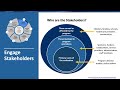
- Title
- Module 2: Video Segment 5: Program Evaluation
- Runtime
- 23:50
- Date posted
- 3 years ago
- Description
- Module 2 segment 5 provides methods and best practices used to evaluate lead exposure prevention programs.

- Title
- Module 2: Video Segment 4: Key Strategy – Targeted, Population-based Interventions
- Runtime
- 34:39
- Date posted
- 3 years ago
- Description
- The purpose of this segment is to guide trainees in developing strategic partnerships and policies, to implement targeted, population-based interventions with a focus on community-based approaches aimed at primary prevention of childhood lead exposures.

- Title
- Module 2: Video Segment 3: Key Strategy – Linkage to Services and Providing Appropriate Follow-up
- Runtime
- 17:23
- Date posted
- 3 years ago
- Description
- Module 2 segment 3 guides trainees in strategies to identify children with blood lead levels requiring follow-up and to connect them to medical, social, behavioral, environmental, or other required services. Details include establishing partnerships with medical, environmental, behavioral, and social services organizations that aid children with blood lead levels above the current reference value. CDC’s current blood lead reference value is 3.5 micrograms per deciliter of blood (μg/dL).

- Title
- Module II Video Segment 2: Key Strategy – Blood Lead Surveillance Systems
- Runtime
- 20:45
- Date posted
- 3 years ago
- Description
- Module 2 Segment 2 is designed to assist trainees in developing or improving surveillance procedures for the collection, quality assurance, analysis, and dissemination of childhood lead exposure blood test results and other data.

- Title
- Module I: Segment 4: Roles and Responsibilities for Jurisdictions and CDC
- Runtime
- 18:03
- Date posted
- 3 years ago
- Description
- This segment introduces the roles of public health department personnel and CDC partners in supporting the implementation of Childhood Lead Poisoning Prevention Programs (CLPPPs) and will assist trainees in identifying how specific public health roles relate to the CDC CLPPP’s four key strategies for managing a CDC-funded program.

- Title
- Module 1: Foundations of Lead Exposure Segment 3: Lead Prevention Programs in Health Departments
- Runtime
- 21:54
- Date posted
- 3 years ago
- Description
- This segment will introduce trainees to four strategic priorities for developing a lead prevention program and define basic concepts: Blood lead testing and reporting, Blood Lead Surveillance, Linkage to Services and Targeted population-based policy interventions. The information conveyed will assist trainees in identifying features of well-run programs and the four major components of state/local/territorial/tribal lead prevention and mitigation programs.
- Title
- Module 1 Foundations of Lead Exposure Segment 2 History of Lead Poisoning and Contemporary Issues
- Runtime
- 49:51
- Date posted
- 3 years ago
- Description
- The segment provides historical context of lead poisoning and evidence to support continuing vigilance in detecting exposures. The content is designed to assist trainees in comprehending the present and past uses of lead, the history and timeline of lead policies in the United States, and the impacts of recent lead exposure incidents within affected communities.

- Title
- Module 1: Foundations of Lead Exposure - Video Segment 1: Lead as a Public Health Concern
- Runtime
- 30:21
- Date posted
- 3 years ago
- Description
- Module 1: Video Segment 1: Lead as a Public Health Concern (30 minutes 20 seconds)
This segment conveys the dynamics of lead exposure as a major public health problem and its continuing impact on children and adults. The information shared will assist trainees in defining lead poisoning, understanding its causes, and identifying the major short- and long-term health outcomes of exposure.

- Title
- Basic Microscopy – Setting Up the Microscope
- Runtime
- 1:07
- Date posted
- 3 years ago
- Description
- Microscopes are important pieces of equipment used in the management of patient care. Compound microscopes have mechanical and optical components essential to their function and use. It is important to set up microscopes for optimal viewing every time it is used. This video gives a brief overview of how to set up a microscope for viewing a specimen on a slide.
This video can also be viewed at
https://reach.cdc.gov/job-aids-resources

- Title
- Basic Microscopy – Microscope Components
- Runtime
- 4:13
- Date posted
- 3 years ago
- Description
- The most common type of microscope is a compound light microscope. It contains two or more lenses and uses visible light to produce a two-dimensional image of an object viewed through the oculars. This video provides a description of the three main sections of a microscope—the head, the arm, and the base—and their important components.
This video can also be viewed at
https://reach.cdc.gov/job-aids-resources

- Title
- Basic Microscopy – Ocular Micrometer Calibration
- Runtime
- 3:30
- Date posted
- 3 years ago
- Description
- Size is one of the most important physical features when identifying and characterizing an organism in the lab. The exact size of an organism can be determined using a calibrated ocular micrometer. An ocular micrometer is a calibrated ruler etched on a glass disk that is used for measuring organisms under a microscope. The ocular micrometer sits inside the eyepiece. This video provides step-by-step instructions on how to calibrate an ocular micrometer on a compound microscope with mathematical calculations. It also shows how to use the stage micrometer, which is a special glass slide clipped to the stage of the slide, to calibrate the ocular micrometer. Calibration should be done separately for each objective lens and different microscopes.
This video can also be viewed at
https://reach.cdc.gov/job-aids-resources

- Title
- Basic Microscopy – Köhler Illumination
- Runtime
- 2:35
- Date posted
- 3 years ago
- Description
- To make an accurate diagnosis, it is necessary to visualize samples as clearly as possible. Köhler illumination is a light microscopy where the user aligns the illuminating optics to produce a uniform background, maximize contrast, minimize artifacts, and reduce stray light. This video is a brief tutorial on how to set Köhler illumination on a compound microscope to get a brilliant image. Please note that the ability to adjust the condenser aperture or field aperture (diaphragm) may vary by manufacturer. Consult your manual for additional instructions.
This video can also be viewed at
https://reach.cdc.gov/job-aids-resources

- Title
- Basic Microscopy – Focusing the Microscope
- Runtime
- 2:06
- Date posted
- 3 years ago
- Description
- A microscope is a very important instrument in the laboratory. It is necessary to focus your microscope when viewing specimens to perform a proper analysis and give an accurate diagnosis. This video gives a brief overview of how to focus on a specimen using a compound microscope. It demonstrates the steps in focusing a compound light microscope from10X to 100X. The use of immersion oil for the 100X lens is also specifically shown.
This video can also be viewed at
https://reach.cdc.gov/job-aids-resources

- Title
- Basic Microscopy – Cleaning the Microscope
- Runtime
- 2:09
- Date posted
- 3 years ago
- Description
- Compound microscopes require regular cleaning to help ensure accurate diagnoses and prevent damage to the microscope. However, microscopes are delicate instruments that must be handled with care. Do not use toilet paper, Kleenex, or paper towels as these may contain particulates that could scratch the lenses. Do not apply pressure. This video walks you through the basic techniques used to clean your microscope from top to bottom. Consult your manual on the preferred cleaning solution.
This video can also be viewed at
https://reach.cdc.gov/job-aids-resources

- Title
- October 2023 ACIP Meeting - COVID-19 Vaccines, Pneumococcal & Influenza vaccines
- Runtime
- 2:00:33
- Date posted
- 3 years ago
- Description
- COVID-19 vaccine implementation; COVID-19 vaccine policy and next steps ; Pneumococcal Work Group Updates and Next Steps; Effectiveness of maternal influenza vaccination during pregnancy against influenza-associated hospitalizations & emergency department visits in infants <6 Months of Age; Update on influenza B/Yamagata surveillance

- Title
- October 2023 ACIP Meeting - Public Comment, Chikungunya & Dengue Vaccines
- Runtime
- 1:30:31
- Date posted
- 3 years ago
- Description
- Public comment; Chikungunya vaccine: EtR and proposed policy options for chikungunya vaccine use among U.S. adults traveling abroad ; EtR and proposed policy options for chikungunya vaccine use among laboratory workers. Dengue Vaccine: Takeda dengue vaccine update

- Title
- October 2023 ACIP Meeting - Combined Immunization Schedules
- Runtime
- 2:04:33
- Date posted
- 3 years ago
- Description
- Introductions; Agency updates; Combined Immunization Schedules: Introduction to 2024 adult and child/adolescent immunization schedule; 2024 child and adolescent schedule revisions ; 2024 adult schedule revisions

- Title
- October 2023 ACIP Meeting - Influenza Vaccines & Vaccine Safety
- Runtime
- 1:25:51
- Date posted
- 3 years ago
- Description
- Introduction; Safety of quadrivalent recombinant influenza vaccine in pregnant women and their infants; Pregnancy outcomes with ccIIV4 (Flucelvax): results of a postmarketing study; Safety of simultaneous versus sequential administration of mRNA ;COVID-19 and Quadrivalent Inactivated Influenza (IIV4) Vaccines: A randomized placebo controlled trial;
Safety of simultaneous vaccination with Zoster Vaccine Recombinant (RZV) and quadrivalent Adjuvanted Inactivated Influenza Vaccine (allV4); Vaccine Safety Update: Update on COVID-19 and Influenza Vaccine Safety

- Title
- October 2023 ACIP Meeting - Public comment & RSV Vaccines
- Runtime
- 2:21:37
- Date posted
- 3 years ago
- Description
- Public comment; VOTES; RSV-Adults: Introduction; GSK safety and immunogenicity in persons 50-59 years of age;Epidemiology of RSV in adults;Work group interpretation and ACIP discussion

- Title
- October 2023 ACIP Meeting - Mpox Vaccines
- Runtime
- 1:57:47
- Date posted
- 3 years ago
- Description
- Introduction; Updates about U.S. mpox epidemiology, vaccine safety, and vaccine effectiveness;Evidence to recommendations framework; Review of voting language and clinical guidance;Vaccines for Children resolution

- Title
- October 2023 ACIP Meeting - Welcome & Meningococcal Vaccines
- Runtime
- 2:44:40
- Date posted
- 3 years ago
- Description
- Introduction; Plan for revisiting adolescent schedule for meningococcal vaccines; Comparison of Pfizer and CDC cost effectiveness analyses; Summary of EtR and proposed recommendations for Pfizer’s ; MenABCWY vaccine ; Vaccines for Children Resolution

- Title
- Diabetes Compass Website: Promotion Video
- Runtime
- 0:15
- Date posted
- 3 years ago
- Description
- Introducing the Your Diabetes Compass Website

- Title
- Diabetes Compass Navigator: Opening Video
- Runtime
- 3:12
- Date posted
- 3 years ago
- Description
- Deborah gives an overview of what you can find on the Your Diabetes Compass website, a tool created specifically for Black Women with type 2 diabetes. She also shares a little background on her own journey with diabetes.
Transcript: https://www.cdc.gov/diabetes/videos/your-diabetes-compass/Diabetes-Compass-Navigator-Opening-Video-transcript.pdf

- Title
- Diabetes Compass Navigator: Monitoring Diabetes
- Runtime
- 1:50
- Date posted
- 3 years ago
- Description
- Deborah talks about the importance of getting the correct supplies for your glucometer to track blood sugar levels.
Transcript: https://www.cdc.gov/diabetes/videos/your-diabetes-compass/Monitoring-Diabetes-transcript.pdf

- Title
- Ask the Experts: A Conversation with Strategic Foresight Leaders
- Runtime
- 50:20
- Date posted
- 3 years ago
- Description
- This October 2023 webinar featured a panel of experts who provided insights on the application of strategic foresight across various settings, including government, industry, and academia.
For more information on Strategic Foresight at NIOSH: https://www.cdc.gov/niosh/topics/foresight/default.html

- Title
- Taking Your Power Back! – Charlene Flash, MD, MPH
- Runtime
- 0:59
- Date posted
- 3 years ago
- Description
- Dr. Flash explains that as a doctor her main goal is allowing patients living with HIV to claim their power back and change the narrative of their HIV diagnosis.
This video is a joint production of KFF's Greater Than HIV and CDC's Let's Stop HIV Together.

- Title
- Getting Help with HIV Treatment – Charlene Flash, MD, MPH
- Runtime
- 1:00
- Date posted
- 3 years ago
- Description
- In this video, Dr. Flash tells us that there are different resources that assist people with HIV with treatment, as well as access to transportation, housing opportunities and more. The Ryan White Program is one of them.
This video is a joint production of KFF's Greater Than HIV and CDC's Let's Stop HIV Together.

- Title
- Do herbal therapies for HIV work? – Charlene Flash, MD, MPH
- Runtime
- 0:55
- Date posted
- 3 years ago
- Description
- Dr. Flash emphasizes that herbal medications do not treat HIV. Antiretrovirals do. If you are taking any herbal medications, it is important to speak with your health provider as there are medications that cannot be taken together.
This video is a joint production of KFF's Greater Than HIV and CDC's Let's Stop HIV Together.

- Title
- Let’s Talk About HIV Testing - Demetre Daskalakis, MD, MPH
- Runtime
- 2:05
- Date posted
- 3 years ago
- Description
- Dr. Demetre highlights the importance of HIV testing and the different options available. HIV testing is not usually routine, ask to be tested. There is a blood drawn lab test, rapid test, finger stick, oral swab and even at home self-test kits.
This video is a joint production of KFF's Greater Than HIV and CDC's Let's Stop HIV Together.

- Title
- Let’s Talk About PrEP - Demetre Daskalakis, MD, MPH
- Runtime
- 1:47
- Date posted
- 3 years ago
- Description
- In this video, Dr. Demetre speaks about PrEP as a form of HIV prevention. This medication allows individuals to be in control of their health. There are different forms: daily PrEP, injectable PrEP or episodic or 211 PrEP. Condoms are also a really good form of taking care of your health.
This video is a joint production of KFF's Greater Than HIV and CDC's Let's Stop HIV Together.

- Title
- Wouldn't I know if I had HIV? – Charlene Flash, MD, MPH
- Runtime
- 0:51
- Date posted
- 3 years ago
- Description
- Dr. Flash shares that HIV symptoms aren’t specific, and some people can experience mild symptoms or be asymptomatic. Left untreated, the immune system weakens so it is important to get tested and seek out a treatment plan.
This video is a joint production of KFF's Greater Than HIV and CDC's Let's Stop HIV Together.

- Title
- 3 Things to Know About HIV Today! Demetre Daskalakis, MD, MPH
- Runtime
- 0:43
- Date posted
- 3 years ago
- Description
- Dr. Demetre shares with us 3 key facts about HIV today and the importance of knowing your status. PrEP prevents HIV. If you are undetectable, you can’t transmit HIV to others.
This video is a joint production of KFF's Greater Than HIV and CDC's Let's Stop HIV Together.
- Title
- Let's Talk About HIV & Pregnancy – Charlene Flash, MD, MPH
- Runtime
- 0:59
- Date posted
- 3 years ago
- Description
- Dr. Flash informs us that people living with HIV can have babies that are not born with HIV. It is important to talk to a healthcare provider and have one’s HIV diagnosis under control.
This video is a joint production of KFF's Greater Than HIV and CDC's Let's Stop HIV Together.
- Title
- Living Well with HIV – Charlene Flash, MD, MPH
- Runtime
- 0:54
- Date posted
- 3 years ago
- Description
- Dr. Flash informs us that individuals can live a healthy life with HIV. Prioritizing treatment is the best way to keep one’s viral load down and stay undetectable.
This video is a joint production of KFF's Greater Than HIV and CDC's Let's Stop HIV Together.
- Title
- Busting HIV Myths - Know It - David Malebranche, MD, MPH
- Runtime
- 0:49
- Date posted
- 3 years ago
- Description
- In this video, Dr. Malebranche talks about how one wouldn’t necessarily know if they had HIV. The best way to know is to get tested and start medication as soon as possible if there is an HIV positive diagnosis.
This video is a joint production of KFF's Greater Than HIV and CDC's Let's Stop HIV Together.

- Title
- Busting HIV Myths - Can't Get - David Malebranche, MD, MPH
- Runtime
- 0:25
- Date posted
- 3 years ago
- Description
- In this video, Dr. Malebranche informs us that HIV is not spread through casual contact.
This video is a joint production of KFF's Greater Than HIV and CDC's Let's Stop HIV Together.

- Title
- HIV and STI Testing – David Malebranche, MD, MPH
- Runtime
- 1:01
- Date posted
- 3 years ago
- Description
- Dr. Malebranche emphasizes the importance of asking to be tested for HIV and STIs when at a doctor’s office. There are different tests available.
This video is a joint production of KFF's Greater Than HIV and CDC's Let's Stop HIV Together.

- Title
- Let’s Talk About HIV Prevention – David Malebranche, MD, MPH
- Runtime
- 1:03
- Date posted
- 3 years ago
- Description
- Dr. Malebranche talks about the different ways to prevent HIV. One, becoming HIV undetectable means a person living with HIV will not transmit HIV to sexual partners. Two, PrEP for people who are not living with HIV to prevent HIV. Three, PEP is more of an emergency backup that one should take within 72 hours of exposure or potential exposure to HIV.
This video is a joint production of KFF's Greater Than HIV and CDC's Let's Stop HIV Together.

- Title
- Let’s Talk About PrEP – David Malebranche, MD, MPH
- Runtime
- 1:28
- Date posted
- 3 years ago
- Description
- In this video, Dr. Malebranche speaks about PrEP as a pill or long-acting injectable that someone who is HIV negative can take in order to prevent getting HIV. Biomedical advances like PrEP provide the option for people who are not living with HIV to take control of their health.
This video is a joint production of KFF's Greater Than HIV and CDC's Let's Stop HIV Together.
- Title
- 3 Things to Know about HIV – Charlene Flash, MD, MPH
- Runtime
- 1:01
- Date posted
- 3 years ago
- Description
- In this video, Dr. Flash shares 3 main facts about HIV. One, HIV can be treated through antiretrovirals. Two, while under HIV treatment, you can become undetectable making it so you can’t transmit HIV to your sexual partner. Three, PrEP prevents HIV.
This video is a joint production of KFF's Greater Than HIV and CDC's Let's Stop HIV Together.

- Title
- Let's Talk about PrEP for Women – Charlene Flash, MD, MPH
- Runtime
- 1:01
- Date posted
- 3 years ago
- Description
- Dr. Flash speaks about how PrEP can empower women to take control of their health and stay protected against HIV.
This video is a joint production of KFF's Greater Than HIV and CDC's Let's Stop HIV Together.

- Title
- PMGR: 2022 CDC Clinical Practice Guideline for Prescribing Opioids for Pain
- Runtime
- 35:35
- Date posted
- 3 years ago
- Description
- The October 2023 Preventive Medicine Grand Rounds (PMGR) features Dr. Kristine Schmit, Medical Officer with the Division of Overdose Prevention, National Center for Injury Prevention and Control at the CDC. She gives an overview of the division’s work and discusses the recently updated clinical practice guideline providing recommendations for effective and safer pain treatment options.
For continuing education (CE) credits, visit https://tceols.cdc.gov/; search for course WD4441-100423. CEs will be available after 11/7/2023 and expire 11/7/2025. Course access code: CDCPMRF
Audio Description Video: https://www.youtube.com/watch?v=sdMmrpY4A90

- Title
- PMGR: 2022 CDC Clinical Practice Guideline for Prescribing Opioids for Pain - Audio Description
- Runtime
- 40:18
- Date posted
- 3 years ago
- Description
- The October 2023 Preventive Medicine Grand Rounds (PMGR) features Dr. Kristine Schmit, Medical Officer with the Division of Overdose Prevention, National Center for Injury Prevention and Control at the CDC. She gives an overview of the division’s work and discusses the recently updated clinical practice guideline providing recommendations for effective and safer pain treatment options.
For continuing education (CE) credits, visit https://tceols.cdc.gov/; search for course WD4441-100423. CEs will be available after 11/7/2023 and expire 11/7/2025. Course access code: CDCPMRF

- Title
- Public Health Careers: Health Communication Specialist, Part 2
- Runtime
- 1:16
- Date posted
- 3 years ago
- Description
- In this career spotlight video, a bilingual health communication specialist from CDC talks about how he got into a public health career. He shares some of the skills that he uses daily and how effective communication helps people stay healthy. This is one of a series of career spotlight videos available at https://www.cdc.gov/scienceambassador/nerdacademy/posters.html.
Audio Description Transcript: https://www.cdc.gov/fellowships/pdfs/federico-feldstein-health-com-specialist-2-unbranded-transcript.pdf

- Title
- Alexis’ Story: Creating Community Support
- Runtime
- 4:47
- Date posted
- 3 years ago
- Description
- Seeking community? Click here to learn more about Alexis and her road to finding sisterly support and fun through the 40+ Double Dutch Club.

- Title
- Marcella’s Story: Living With Diabetes
- Runtime
- 3:52
- Date posted
- 3 years ago
- Description
- Watch as Marcella finds purpose in serving her community, while living with diabetes.
Transcript: https://www.cdc.gov/diabetes/videos/your-diabetes-compass/Marcella-Story-Living-With-Diabetes-transcript.pdf

- Title
- Mia’s Story: Finding the Right Provider
- Runtime
- 2:53
- Date posted
- 3 years ago
- Description
- Looking for the right health care provider? Click here to learn more about Mia’s relationship with her personal physician.
Transcript: https://www.cdc.gov/diabetes/videos/your-diabetes-compass/Mia-Story-Finding-the-Right-Healthcare-Provider-transcript.pdf
- Title
- Kineka’s Story: Getting Quality Care
- Runtime
- 2:17
- Date posted
- 3 years ago
- Description
- Listen to Kineka share more on the ups and downs of her diagnosis story and pathway to quality care.
Transcript: https://www.cdc.gov/diabetes/videos/your-diabetes-compass/Kineka-Story-Getting-Quality-Care-transcript.pdf

- Title
- Velma’s Story: Increasing Physical Activity
- Runtime
- 3:41
- Date posted
- 3 years ago
- Description
- Sisters are doing it for themselves! Take a look at how Velma and her sister are pounding the pavement and staying active to help manage their diabetes.
Transcript: https://www.cdc.gov/diabetes/videos/your-diabetes-compass/Velma-Story-Increasing-Physical-Activity-transcript.pdf

- Title
- Kineka’s Story: Monitoring Diabetes
- Runtime
- 2:18
- Date posted
- 3 years ago
- Description
- Learn more about how Kineka monitors her diabetes in a professional setting.
Transcript: https://www.cdc.gov/diabetes/videos/your-diabetes-compass/Kineka-Story-Monitoring-Diabetes-transcript.pdf