Chatham House
Will the US continue to support Israel?

- Title
- Will the US continue to support Israel?
- Runtime
- 35:59
- Date posted
- 2 years ago
- Description
- In this special episode, Bronwen Maddox interviews a key figure in US foreign policy to the Middle East for over a decade, Ambassador Dennis Ross.
Ambassador Ross engaged directly with both Israeli and Palestinian parties in peace negotiations under multiple US presidents, and was instrumental in brokering agreements between them, including the ‘Oslo II’ accord of 1995 and the 1997 Hebron Accord.
They discuss topics including the US-Israel relationship, what pressure President Biden can exert on Benjamin Netanyahu over a possible invasion of Rafah, global protests against Israeli action in Gaza and whether any hope remains for a deal to end the conflict.
More ways to listen:
https://podcasts.apple.com/gb/podcast/will-the-us-continue-to-support-israel/id1499634628?i=1000655153074
https://open.spotify.com/episode/3cqGIcH3Lto8KkjJZd6bPa

- Title
- Unlocking the UK’s leadership potential on global goals and climate
- Runtime
- 1:06:50
- Date posted
- 2 years ago
- Description
- In this conversation with Ban Ki-moon and Mary Robinson, this event discusses:
What role can the UK play in driving forward climate action and how can we unlock the UK’s leadership potential on delivering an ambitious outcome at COP29?
With the future of food under threat, notably for millions of smallholder farmers, how can governments support their adaptive capacity?
How should the global community support developing countries hit by worsening climate change-fuelled disasters?
How can governments set an ambitious new finance goal that reflects the needs and priorities of developing countries, particularly on adaptation?
What lessons can we draw from previous experience on setting global goals?

- Title
- In conversation with the Rt Hon Theresa May
- Runtime
- 1:04:18
- Date posted
- 2 years ago
- Description
- Prime minister for three years and home secretary for six years, Theresa May has been at the heart of decision making for almost a decade, confronting a series of issues in which the abuse of power led to devastating results.
The effects were felt by individuals and unfortunate victims, and significantly damaged the reputation of, and trust in, public institutions and politicians. From the Hillsborough and Grenfell tragedies, to the Daniel Morgan case and parliamentary scandals, the powerful repeatedly chose to use their power not in the interests of the powerless but to serve themselves or to protect the organization to which they belonged.
Drawing on examples from domestic and international affairs she was personally involved in at the highest level, including Stop and Search and the Salisbury Poisonings, the former prime minister argues for a radical rethink in how we approach our politics and public life. Mrs May will be discussing how governments los...

- Title
- The future of Europe: Strategic perspectives of the incoming Hungarian EU Presidency
- Runtime
- 1:01:22
- Date posted
- 2 years ago
- Description
- In conversation with Minister of Foreign Affairs and Trade of Hungary, Péter Szijjártó.
Europe is at a crossroads. The war in Ukraine continues with no end apparent as yet. Important European Parliament elections are taking place in June with the Bloc’s political future uncertain. Further afield, Israel’s conflict in Gaza and tension in the Middle East has also had wider global repercussions. And with 2024 dubbed, ‘the year of elections’, much of the world anxious as to the viability of democracies worldwide, with a firm eye on the United States in November.
On July 1st 2024, Hungary will assume the presidency of the European Council. With a multitude of challenges in Hungary, Europe and around the world, there is plenty to occupy Budapest during its 6-month term. Minister of Foreign Affairs and Trade of Hungary, Péter Szijjártó, will discuss how Hungary intends to utilise its presidency, as well as the wider perspectives from Hungary on the ...

- Title
- A turning point for US foreign policy?
- Runtime
- 1:05:19
- Date posted
- 2 years ago
- Description
- As the 2024 US elections draw closer, the rest of the world is seeking a clarity on the future of US global priorities. With two wars dominating international headlines, and roiling politics inside the US, including in the US Congress, the Biden administration is under growing pressure to change course and deliver stability in the Middle East, and also to set clearer goals with respect to Ukraine.
With the 2024 US presidential election approaching, questions are mounting domestically over the Biden administration’s handling of the Gaza war and its wider policy towards the Middle East.
Questions to be discussed include:
How will the upcoming US presidential election influence US strategy in the Middle East?
What should the role of the US be in brokering a cessation in the conflict?
How is US strategy being shaped by the broader foreign policy agenda and by domestic electoral concerns?

- Title
- Surviving in conflict
- Runtime
- 1:33:39
- Date posted
- 2 years ago
- Description
- Civilians continue to bear the brunt of armed conflicts. As hostilities are increasingly waged in urban areas, civilians have been caught up in fighting in Gaza, Yemen, Ukraine, and Sudan. Military operations have caused civilian death and injury, lack of much needed services, and the destruction of homes and basic infrastructure.
To alleviate suffering, there have been calls in these conflicts to establish arrangements, including notifications, evacuations, humanitarian corridors, and suspensions of hostilities, devised to spare civilians from the effects of hostilities and to facilitate humanitarian relief operations. However, to ensure their effectiveness, there first needs to be a common understanding around what they are, what they entail operationally, and the interplay between arrangements and the rules of international humanitarian law (IHL).
With experience in the implementation of humanitarian arrangements, panellists discuss how arrangements can con...

- Title
- Making transgressors pay session 4: The Rt Hon Victoria Prentis KC MP, UK Attorney General
- Runtime
- 22:39
- Date posted
- 2 years ago
- Description
- Our 'making transgressors pay' event discussed the arguments for and against repurposing frozen state-owned Russian assets.
In this session Rashmin Sagoo, Director, International Law Programme, Chatham House explores the legal issues involved with The Rt Hon Victoria Prentis.

- Title
- Making transgressors pay session 6: Closing remarks
- Runtime
- 10:46
- Date posted
- 2 years ago
- Description
- Our 'making transgressors pay' event discussed the arguments for and against repurposing frozen state-owned Russian assets.
In this video Fen Hampson, President, World Refugee & Migration Council and James Nixey, Director, Russia-Eurasia Programme, Chatham House deliver closing remarks to the event.

- Title
- Making transgressors pay session 5: Asset repurposing
- Runtime
- 1:12:00
- Date posted
- 2 years ago
- Description
- Our 'making transgressors pay' event discussed the arguments for and against repurposing frozen state-owned Russian assets. This session explores:
If sanctioned assets are repurposed for use in Ukraine, how can they be used most effectively (EG for current defence or future reconstruction)?
What additional institutional arrangements do Ukraine and partner governments need to put in place to ensure effective governance and efficient handling of the financial flows from
repurposed assets?

- Title
- Making transgressors pay session 3: Theory and practice
- Runtime
- 1:16:50
- Date posted
- 2 years ago
- Description
- Our 'making transgressors pay' event discussed the arguments for and against repurposing frozen state-owned Russian assets. This session explores:
What are the main approaches that have been implemented and/or proposed to date (including Canada’s C19 legislation, the EU’s mechanism for confiscating income from sanctioned assets and various proposals for issuing bonds collateralized by sanctioned assets or the income they generate)?
What are the main outstanding financial market, legal and political concerns with respect to these proposals? How do they vary with the objective of the sanctions or repurposing?
What mitigations are available?

- Title
- Making transgressors pay session 2: Chrystia Freeland PC MP
- Runtime
- 34:35
- Date posted
- 2 years ago
- Description
- Our 'making transgressors pay' event discussed the arguments for and against repurposing frozen state-owned Russian assets.
In the keynote speech, Chrystia Freeland PC MP, Deputy Prime Minister and Finance Minister of Canada discussed the issues involved with Bronwen Maddox, Director and Chief Executive, Chatham House.
- Title
- Making transgressors pay session 1: Welcome and objectives
- Runtime
- 10:51
- Date posted
- 2 years ago
- Description
- Our 'making transgressors pay' event discussed the arguments for and against repurposing frozen state-owned Russian assets.
In this video Creon Butler, Director, Global Economy and Finance Programme, Chatham House and The Hon Lloyd Axworthy, Chair, World Refugee & Migration Council, deliver opening remarks to the event.

- Title
- Which country is next to go nuclear?
- Runtime
- 40:30
- Date posted
- 2 years ago
- Description
- This week, Bronwen Maddox discusses whether we are seeing a resurgence of the threat posed by nuclear weapons, given recent events in the Middle East and rhetoric from world leaders.
She is joined by Robert E Kelly, Professor of Political Science at Pusan National University, Dr Hanna Notte, Director of the Eurasia Nonproliferation Program at the James Martin Center for Nonproliferation Studies and Dr Patricia Lewis, Director of the International Security Programme at Chatham House.
Independent Thinking is a weekly international affairs podcast hosted by our director Bronwen Maddox, in conversation with leading policymakers, journalists, and Chatham House experts providing insight on the latest international issues.
More ways to listen:
https://podcasts.apple.com/gb/podcast/independent-thinking/id1499634628
https://open.spotify.com/episode/61MP7tP8SzbAjBxYX907ZU

- Title
- How to bolster Ukraine's wartime resilience (Ukrainian language)
- Runtime
- 1:31:42
- Date posted
- 2 years ago
- Description
- In the face of protracted war, Ukrainian society and economy have shown noteworthy resilience. Ukrainian civil society and the private sector have played vital roles in filling gaps where state support is limited. Local communities and mayors deal with the influx of veterans, displaced persons, and the consequences of daily aerial strikes.
However, delayed Western military assistance, pressure to reconstitute armed forces, and devastating attacks on energy infrastructure add new pressure and risk causing systemic damage to Ukraine’s capacity to resist Russian invasion. The most recent World Bank assessment puts the annual destruction bill at $75 billion.
In preparation for the 2024 Ukraine Recovery Conference in Berlin, this discussion explores how Ukraine’s partners can support and bolster its resilience during times of war. The discussion also draws upon a recent Resilience Barometer publication from Chatham House and new research on individual resilienc...

- Title
- How to bolster Ukraine's wartime resilience
- Runtime
- 1:31:42
- Date posted
- 2 years ago
- Description
- In the face of protracted war, Ukrainian society and economy have shown noteworthy resilience. Ukrainian civil society and the private sector have played vital roles in filling gaps where state support is limited. Local communities and mayors deal with the influx of veterans, displaced persons, and the consequences of daily aerial strikes.
However, delayed Western military assistance, pressure to reconstitute armed forces, and devastating attacks on energy infrastructure add new pressure and risk causing systemic damage to Ukraine’s capacity to resist Russian invasion. The most recent World Bank assessment puts the annual destruction bill at $75 billion.
In preparation for the 2024 Ukraine Recovery Conference in Berlin, this discussion explores how Ukraine’s partners can support and bolster its resilience during times of war. The discussion will also draw upon a recent Resilience Barometer publication from Chatham House and new research on individual resil...

- Title
- Is time running out for Ukraine?
- Runtime
- 38:49
- Date posted
- 2 years ago
- Description
- Bronwen Maddox is joined this week by journalist Oz Katerji and Phillips P. O’Brien, a Professor of Strategic Studies at the University of St Andrews. Joining them both in the studio is Ukrainian journalist Olga Tokariuk, the OSUN Academy Fellow in the Ukraine Forum at Chatham House.
More ways to listen:
https://podcasts.apple.com/gb/podcast/is-time-running-out-for-ukraine/id1499634628?i=1000653664970
https://open.spotify.com/episode/0faOV9iWlqnCWnkRMWEMTa?si=T8X21U7bQo2BDSm5akloMA
- Title
- The future of American conservatism
- Runtime
- 57:18
- Date posted
- 2 years ago
- Description
- Former US President Ronald Reagan is credited with ushering in a new era of conservatism during his time in office, introducing policies that minimized federal responsibility in addressing social problems, reduced restrictions on business, introduced tax cuts, and increased funding for defence.
Following Reagan’s presidency, this new form of conservatism became prominent in US national politics and provided a foundation for the growth of the populist movement which helped elect US President Donald Trump to office in 2016. While in office, however, Trump’s policies diverged from traditional Republican views and the Republican Party appears to have been transformed.
What drivers are influencing the Republican Party today? How will the party continue to develop and what will be the main priorities for the GOP post 2024?
- Title
- How India's democracy shapes its relations with the West
- Runtime
- 1:01:00
- Date posted
- 2 years ago
- Description
- This event launched the new Chatham House research paper 'How India’s democracy shapes its global role and relations with the West', available here:
https://www.chathamhouse.org/2024/04/how-indias-democracy-shapes-its-global-role-and-relations-west?utm_source=youtube.com&utm_medium=referral&utm_campaign=app&utm_content=india_democracy
The West has long held up India’s democracy as one of the pillars of its engagement with the country. India has also touted its status as the world’s largest democracy as part of its claim to global leadership. While this may seem rhetorical, it alludes to the fact that the West’s relations with India are seen to be underpinned by not just shared interests, but also shared values.
However, Indian foreign policy often appears out of sync with Western democracies and New Delhi rarely employs democracy promotion as an explicit tool of its foreign policy.
At this webinar experts discuss:
...

- Title
- Britain’s economic security
- Runtime
- 59:41
- Date posted
- 2 years ago
- Description
- The experience of Russia’s invasion of Ukraine and COVID-19 brought into focus the risks posed by fragile supply chains and economic dependencies on hostile and authoritarian states. More and more, governments around the world are bringing in measures to diversify or ‘de-risk’ their supply chains and other economic links. They are seeking to protect their economies from both global crises, the possibility of economic coercion, and other attempts at weaponizing economic links and legitimate economic interactions.
For the UK, this issue has been a long-running concern, with the fierce debate in 2020 over whether the country should incorporate Huawei into its 5G infrastructure highlighting difficult questions about how to manage strategic and economic links with Chinese companies. As Secretary of State for the Department for Culture, Media and Sport at the time, Oliver Dowden played a leading role in the government’s decision to ban Huawei from the UK’s 5G network...

- Title
- Israel-Palestine: The health of Gaza
- Runtime
- 59:13
- Date posted
- 2 years ago
- Description
- Six months on from the 7 October Hamas attacks, Israel’s military offensive in Gaza has left many Palestinian civilians in dire need of urgent medical attention. With continuing strikes on the Rafah crossing stopping the delivery of essential medical aid, the health system in the Strip has been crippled with no capacity to respond to the immense demand from the growing number of injured people desperately seeking medical attention. Worsening food insecurity continues to further endanger Gazan’s health and add pressure to the health system. In February 2024, senior UN officials warned of imminent famine in the strip if the current situation continues.
There is the additional cost beyond the war’s victims. With food, water, medicine, treatment and care prevented from reaching the vulnerable and sick, thousands are struggling on a daily basis to survive. As the health system collapses, outbreaks of disease are far more likely. Mass displacement of civilians will add t...

- Title
- Are Israel and Iran on the brink of all out war?
- Runtime
- 30:08
- Date posted
- 2 years ago
- Description
- Bronwen Maddox is joined this week by Sanam Vakil, the director of our Middle East programme to discuss Iran's missile attack on Israel and the possible consequences across the region. Joining them both are Professor Yossi Mekelberg and Dr Elham Fakhro, Associate Fellows with our Middle East programme.
Independent Thinking is a weekly international affairs podcast hosted by our director Bronwen Maddox, in conversation with leading policymakers, journalists, and Chatham House experts providing insight on the latest international issues.
More ways to listen:
https://podcasts.apple.com/gb/podcast/are-israel-and-iran-on-the-brink-of-all-out-war/id1499634628?i=1000652971941
https://open.spotify.com/episode/4NBSl8o6cS6YI68LPUIgKM?si=4iyHg36FQo6RbTWsKtf50A

- Title
- US-ROK-Japan cooperation in an age of crisis
- Runtime
- 1:02:58
- Date posted
- 2 years ago
- Description
- Over the past year, North Korea has heightened its provocative behaviour, while strengthening its relationship with Russia. In January, Kim Jong Un outlined a shift away from reunification with South Korea as a foreign policy objective.
These actions, together with an increasingly assertive China, raise pressing questions for how Japan, South Korea, and the United States should cooperate in addressing security issues on the Korean Peninsula and across Northeast Asia.
In this webinar our panel of experts discuss:
What are the main challenges facing bilateral and trilateral coordination between the United States, Japan, and South Korea?
How should these countries strengthen bilateral and trilateral cooperation as they confront regional threats from North Korea and China?
As the Biden administration approaches the end of its first term in office, what will be the likely outcomes of Biden’s meeting with Kishida?
How might US–Sou...

- Title
- Has the world forgotten Sudan?
- Runtime
- 34:51
- Date posted
- 2 years ago
- Description
- Bronwen Maddox is joined this week by Mohammed al-Ta’ishi, a civilian member of Sudan’s Sovereignty Council - where he served as the chief negotiator and main architect of the Juba Peace Agreement. Joining them both are BBC journalist James Copnall and Rosalind Marsden, an Associate Fellow with our Africa programme and the former UK ambassador to Sudan.
Independent Thinking is a weekly international affairs podcast hosted by our director Bronwen Maddox, in conversation with leading policymakers, journalists, and Chatham House experts providing insight on the latest international issues.
More ways to listen:
https://podcasts.apple.com/gb/podcast/has-the-world-forgotten-sudan/id1499634628?i=1000652230248
https://open.spotify.com/episode/4BlkzBF85luQflbCVHsWRY

- Title
- Two years to save the world
- Runtime
- 1:02:43
- Date posted
- 2 years ago
- Description
- Executive Secretary of UN Climate Change, Simon Stiell, lays out what needs to be done by COP30, and its long-term significance.
Background:
On climate, the world has gone from denial to procrastination. Climate inaction is no longer defended by denying the science, but because action is claimed to be ‘too costly’ or unachievable. Yet the time to shape a liveable future is running out, with the decisions taken over the coming two years determining how close to limiting global warming to 1.5°C we will get by the end of the century.
With more than 60 countries going to the polls this year, and nearly 90 per cent of the population in 125 countries wanting stronger climate action, every election is a climate change election. We must now see climate action as a tool to create better, more equitable and cleaner societies, with solid economies built around plentiful, renewable energy.
Key questions discussed include:
How ca...

- Title
- Has Turkey turned against Recep Tayyip Erdoğan?
- Runtime
- 33:33
- Date posted
- 2 years ago
- Description
- Bronwen Maddox is joined by Soli Özel, a Professor of International Relations at Istanbul Kadir Has University, and Hürcan Aslı Aksoy, the Head of the Centre for Applied Turkey Studies at the German Institute for International and Security Affairs. With them is Galip Dalay, a Senior Consulting Fellow with our Middle East and North Africa programme.
Independent Thinking is a weekly international affairs podcast hosted by our director Bronwen Maddox, in conversation with leading policymakers, journalists, and Chatham House experts providing insight on the latest international issues.
More ways to listen:
https://podcasts.apple.com/gb/podcast/has-turkey-turned-against-recep-tayyip-erdo%C4%9Fan/id1499634628?i=1000651524506
https://open.spotify.com/episode/74YcLC7SQvCEUbRnzerqCN?si=jjmTJJcZQ2a6R1-71CK8Rw

- Title
- The conflict economy of sesame in Ethiopia and Sudan
- Runtime
- 6:32
- Date posted
- 2 years ago
- Description
- As part of our Cross-Border Conflict Evidence, Policy and Trends (XCEPT) research programme, funded by UK International Development, Senior Research Fellow Ahmed Soliman discusses the research paper ‘The "conflict economy" of sesame in Ethiopia and Sudan: How the sector has become entangled in local and transnational conflict, and how policymakers need to respond’.
Learn more about the XCEPT project: https://www.chathamhouse.org/about-us/our-departments/middle-east-and-north-africa-programme/cross-border-conflict-evidence

- Title
- Can Germany lead in a divided Europe?
- Runtime
- 34:21
- Date posted
- 2 years ago
- Description
- Bronwen Maddox is joined this week by Mujtaba Rahman, the Managing Director Europe of the Eurasia Group and Georgina Wright, a Senior Fellow with Institut Montaigne. Joining them all is journalist John Kampfner, the former head of Chatham House's UK in the World Programme.
Independent Thinking is a weekly international affairs podcast hosted by our director Bronwen Maddox, in conversation with leading policymakers, journalists, and Chatham House experts providing insight on the latest international issues.
More ways to listen:
https://podcasts.apple.com/gb/podcast/can-germany-lead-in-a-divided-europe/id1499634628?i=1000650606758
https://open.spotify.com/episode/7IfszUc5CzUYizXmOhM6Je?si=35d339cead9d4819

- Title
- Russian interference in Moldova
- Runtime
- 2:58
- Date posted
- 2 years ago
- Description
- Valeriu Pasha, Chairman of the WatchDog.md Community, discusses:
How vulnerable is Moldova to Russian interference?
How did Russia try to influence recent local elections?
What policies could strengthen Moldova’s resilience?
This video is part of Chatham House research funded by the National Endowment for Democracy. Read our Moldova Resilience Barometer: countering malign foreign interference.
https://www.chathamhouse.org/sites/default/files/2024-03/2024-03-22-resilience-barometer.pdf

- Title
- Senegal, Nigeria and the Sahel: can democracy deliver in West Africa?
- Runtime
- 38:39
- Date posted
- 2 years ago
- Description
- Bronwen Maddox is joined from Dakar, Senegal by Gilles Yabi, the founder and CEO of WATHI, the West Africa Citizen Think Tank and Idayat Hassan, a Senior Associate with CSIS. Joining them in the Chatham House studio is Paul Melly, a Consulting Fellow with our Africa Programme.
Independent Thinking is a weekly international affairs podcast hosted by our director Bronwen Maddox, in conversation with leading policymakers, journalists, and Chatham House experts providing insight on the latest international issues.
More ways to listen:
https://podcasts.apple.com/gb/podcast/senegal-nigeria-and-the-sahel-can-democracy-deliver/id1499634628?i=1000650105919
https://open.spotify.com/episode/1l8VsPvXxd20U4lQ5WAouK

- Title
- Responding to instability in Iraq’s Sinjar district
- Runtime
- 6:01
- Date posted
- 2 years ago
- Description
- As part of our Cross-Border Conflict Evidence, Policy and Trends (XCEPT) research programme, funded by UK International Development, Associate Fellow Dr Zmkan Saleem and Senior Research Fellow Dr Renad Mansour discuss the research paper 'Responding to instability in Iraq’s Sinjar district: How a remote area of Iraq became a transnational conflict hub, and what this means for peacebuilding in the Middle East'.
Learn more about XCEPT project: https://www.chathamhouse.org/about-us/our-departments/middle-east-and-north-africa-programme/cross-border-conflict-evidence

- Title
- A year on from Nigeria's 2023 elections
- Runtime
- 1:28:41
- Date posted
- 2 years ago
- Description
- In Nigeria’s 2023 elections President Bola Ahmed Tinubu assumed power following a contested election that saw a voter turnout of just 25.7 per cent and subsequent legal challenges from his opponents.
These presidential, legislative, and gubernatorial elections faced many challenges, including technological failures of the Bimodal Voter Accreditation System (BVAS) and with the Independent National Election Commissions results viewing portal (IReV).
Yet analysts agree technology was not the sole issue and election observer missions identified various challenges throughout the electoral process, evidence that there are lessons to be learned from Africa’s largest democracy.
At a time of acute regional instability, highlighted by democratic backsliding, a wave of coups and rising extremism, speakers discuss:
Recommendations from the Commonwealth Observer Group’s election report.
Local conclusions and lessons learned.
Rec...

- Title
- Making sanctions work as a foreign policy tool: The Rt Hon Anne-Marie Trevelyan MP
- Runtime
- 26:57
- Date posted
- 2 years ago
- Description
- Sanctions are a prominent instrument of foreign and security policy. In the context of increasing global threats, they are being deployed in different circumstances and to achieve a range of objectives, but debate continues over how and when they are effective.
The UK has played a key role in the design and deployment of sanctions over many years, linked in part to its role as a permanent member of the UN Security Council. The UK’s departure from the EU, combined with the unprecedented scale of sanctions adopted by G7 partners in response to Russia’s attack on Ukraine, has led to a major restructuring and expansion in the UK government’s sanctions effort.
On 22 February the UK government published a new sanctions strategy under the rubric ‘Deter, Disrupt and Demonstrate’. The strategy provides an end-to-end guide of the UK government’s approach – including decision-making criteria and guiding principles, international partnerships, and investment...

- Title
- How safe is America’s democracy?
- Runtime
- 1:05:29
- Date posted
- 2 years ago
- Description
- Still raw in people’s minds, there is a nervousness around the stability of US democracy in the first presidential election since the events of 6 January 2021 at the US Capitol.
Extremism is now viewed by many as major threat to the country. Radical ideologies and conspiracies have been unfolding over many decades and now pose a threat to the foundations of the American democratic system. There is concern for the safety and security of the country when the election results are confirmed in late 2024.
The threat is not confined to the physical space. Mis- and dis-information online provide new technological challenges to the authorities, notably the rise of AI and deep fakes, to keep the election process fair and ordered. Will America be able to overcome these challenging times as it heads to the polls in November?
Experts will discuss:
What are the most prominent threats to American democracy today?
Is the greater thr...

- Title
- How has MENA turmoil affected external powers’ interests?
- Runtime
- 1:01:21
- Date posted
- 2 years ago
- Description
- The war in Gaza has taken a regional dimension that risks creating broader turmoil across the Middle East and North Africa (MENA).
While the United States has been engaged in diplomatic efforts aimed at a humanitarian pause in the fighting in Gaza, Washington has also responded to attacks by armed groups from the ‘axis of resistance’ in Syria and Iraq. The US, along with the UK, launched strikes on Yemen’s Houthis to counter assaults on shipping in the Red Sea. However, the US and, to a lesser extent, the UK’s activism has prompted criticism from Russia and China who consider Western strikes illegal despite the lack of such designation in the UN Security Council.
Russia seems eager to break through its international isolation over the war in Ukraine by trying to mediate and deepen ties with key Palestinian factions set to meet in Moscow on 26 February. Meanwhile, China’s commercial interests are negatively affected by the Houthis’ attacks on in...
- Title
- How is Eastern Mediterranean geopolitics shifting?
- Runtime
- 1:30:04
- Date posted
- 2 years ago
- Description
- Before 7 October, de-escalation of tensions was the order of the day in the Eastern Mediterranean, mirroring a region-wide trend in the Middle East.
Turkey was mending ties with Israel and Egypt, in order to decouple these states from Greece: growing convergence and cooperation in energy and security matters between Greece, Israel, and Arab states in the Eastern Mediterranean, which institutionally took the form of the Eastern Mediterranean Energy Forum, have been a major concern for Turkey over the last decade.
However, recent months have seen a marked reduction in tension between Ankara and Athens. These two contradictory trends – the Israel–Palestine conflict and thaw in Greece–Turkey relations – are likely to have major impact on the security of the region, and on cooperation and competition between major players there.
This session examines:
What does de-escalation between Greece and Turkey mean for the resolution of the...
- Title
- China's National People's Congress: the view from Japan
- Runtime
- 30:48
- Date posted
- 2 years ago
- Description
- Bronwen Maddox is in Japan this week, and is joined from Taipei by journalist Bethany Allen to discuss China's National People's Congress and the political calculations of Beijing's neighbours. Joining them are Robert Ward from The International Institute for Strategic Studies and Dr Yu Jie – a Senior Fellow with our Asia-Pacific programme.
Independent Thinking is a weekly international affairs podcast hosted by our director Bronwen Maddox, in conversation with leading policymakers, journalists, and Chatham House experts providing insight on the latest international issues.
More ways to listen:
https://podcasts.apple.com/gb/podcast/chinas-national-peoples-congress-the-view-from-japan/id1499634628?i=1000649175472
https://open.spotify.com/episode/25v30uN7MsRSpEcMFzsHyi

- Title
- Energy security in the UK
- Runtime
- 32:28
- Date posted
- 2 years ago
- Description
- Claire Coutinho, Secretary of State, Department of Energy Security and Net Zero, gives the keynote speech at our Energy Transitions Conference 2024.
During her speech she discusses how the UK maintained its energy supplies following Russia's invasion of Ukraine, and how the country is adapting to an era where energy supply can be weaponized.
She outlines how a future system can supply cheap and secure energy, setting out the role of nuclear, wind, oil and gas in the energy transition. She also examines access to critical minerals, and the role of technology including carbon capture.
She also covers investment in British energy, and how the UK can help developing nations with their own energy transitions.

- Title
- How Russia is governed
- Runtime
- 1:04:52
- Date posted
- 2 years ago
- Description
- In March, Vladimir Putin will start yet another six-year presidential term. But despite the absurdity of a ‘presidential election’ in Russia, the run-up to it and the event itself offer insight into how the country works – 24 years into Putin’s regime and during wartime.
The challenges of staying in power in this context are considerable, and only partly mitigated by dealing with opposition in different ways – Navalny and Nadezhdin most recently. The Russian state has been transformed for multiple reasons: to assist in its prosecution of the war, to maintain control and stability, and simply to keep on going.
This discussion will offer a closer look at how the regime maintains itself, and how Russia’s ruling class has evolved over the past two years.
Key questions:
How are the elites changing?
What are the differences between how Russia is governed in the cities and in the provinces?
What strategies does the Kr...

- Title
- Joining in wars
- Runtime
- 1:27:07
- Date posted
- 2 years ago
- Description
- It is increasingly common for states to support other states in armed conflict. Russia’s invasion of Ukraine, for example, has prompted concerns around wider third-party involvement. Actors involved in conflict rely on the provision of military, financial, and intelligence assistance from other states, international organizations, and non-state actors.
This raises the important question of when and under what circumstances states and armed groups providing assistance during armed conflicts become party to that conflict. Being party to an armed conflict raises significant legal and political implications. It is therefore crucial to identify when providing assistance crosses the line into co-party status, so that actors can be aware of their ensuing obligations.
This discussion explores when the provision of military assistance can make an actor party to an armed conflict, and the political and legal implications of this status.
What significance ...

- Title
- Has Donald Trump changed US foreign policy forever?
- Runtime
- 32:44
- Date posted
- 2 years ago
- Description
- Guest host Leslie Vinjamuri is joined on the podcast this week by Ben Smith, the Editor-in-Chief of Semafor News and Professor Jennifer M Lind – an Associate Fellow with our US and Americas programme.
Independent Thinking is a weekly international affairs podcast hosted by our director Bronwen Maddox, in conversation with leading policymakers, journalists, and Chatham House experts providing insight on the latest international issues.
More ways to listen:
https://podcasts.apple.com/gb/podcast/has-donald-trump-changed-us-foreign-policy-forever/id1499634628?i=1000648516155
https://open.spotify.com/episode/2haFcvUcDFBF12xi6H3DcP

- Title
- The role of the UK in the global trade landscape
- Runtime
- 29:37
- Date posted
- 2 years ago
- Description
- The Rt Hon Kemi Badenoch MP, Secretary of State, Department for Business and Trade, discusses the UK’s trade ambitions, outlining her aims to grow exports, improve investment, sign trade deals and defend free trade - citing its power to improve living standards, create jobs and improve people’s lives.
She discusses her recent visit to the World Trade Organization ministerial, the impact of the war in Ukraine, and the part trade wars play in aggravating global tensions.
Her address is followed by a discussion with Creon Butler, Director, Global Economy and Finance Programme at Chatham House.

- Title
- Niger’s coup and regional security implications
- Runtime
- 1:00:37
- Date posted
- 2 years ago
- Description
- Despite the fallout of the July 2023 military coup that deposed Niger’s President Mohamed Bazoum and the imposition of sanctions by the Economic Community of West African States (ECOWAS), the Nigerien junta has continued to consolidate its power. As a result, the prospects for returning to democratic rule and resolving the security crisis in the Sahel remain grim.
The international community’s strong condemnation of the coup, most notably by France and the EU – the biggest development and security support contributor to Niger – was met with anger by the military leaders and led to the withdrawal of French counter-insurgency troops from Niger. The military leaders have subsequently also indicated that they will reverse the law on countering human smuggling to Libya.
Amid recent mediation efforts to return Niger to constitutional order, an announcement by the military junta of their intention (along with Burkina Faso and Mali) of leaving ECOWAS, and ...

- Title
- Who is winning in the Black Sea?
- Runtime
- 1:33:25
- Date posted
- 2 years ago
- Description
- The Kremlin’s strategic goal to control Ukrainian coastline has brought renewed interest to the Black Sea region. While Ukraine has had considerable success in this area, it remains fiercely contested, with disruptions such as floating naval mines affecting the global shipping and trade routes.
This event examines how the Russian invasion of Ukraine has redefined the security landscape of the Black Sea region. It discusses the impact of the war on main stakeholders in the region and address the following questions:
How has the Russo-Ukrainian war changed regional security dynamics in the Black Sea?
How important is the Black Sea to the overall course of the war?
What are security and geopolitical impacts of this war in the Black Sea beyond Russia and Ukraine?
How are major regional powers repositioning themselves in the new regional setting?
What should a winning EU and NATO strategy for the Black Sea look like?
Will the Black S...

- Title
- In conversation with General Tareq Saleh - Arabic language version
- Runtime
- 44:47
- Date posted
- 2 years ago
- Description
- General Tareq Saleh, Vice President, Presidential Leadership Council (PLC), Commander of the Yemeni National Resistance, is interviewed by Farea Al-Muslimi, Research Fellow, MENA Programme, Chatham House.
More on Yemen from Chatham House: https://www.chathamhouse.org/regions/middle-east-and-north-africa/yemen
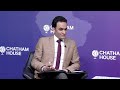
- Title
- In conversation with General Tareq Saleh - English language version
- Runtime
- 44:47
- Date posted
- 2 years ago
- Description
- General Tareq Saleh, Vice President, Presidential Leadership Council (PLC), Commander of the Yemeni National Resistance, is interviewed by Farea Al-Muslimi, Research Fellow, MENA Programme, Chatham House.
More on Yemen from Chatham House: https://www.chathamhouse.org/regions/middle-east-and-north-africa/yemen

- Title
- Attacks in the Red Sea - Arabic language version
- Runtime
- 1:00:48
- Date posted
- 2 years ago
- Description
- Recent attacks by Yemen’s Houthis on ships crossing the Red Sea have taken centre stage in world news. The strikes by the Iran-backed armed group aim to retaliate against Israel’s war in Gaza and demonstrate support for the Palestinians, but it has also put pressure on international shipping and trade prompting a military response from the US and UK. Washington has also re-designated the Houthis a terrorist organization.
This public event convenes Yemeni and international policymakers and experts to discuss the impact and trajectory of the instability in the Red Sea. Panellists will address the following key questions:
How are the Houthi attacks impacting global trade and economic dynamics?
What are the prospects for further military escalation in the region?
What can we expect from the Houthis and how would western countries respond?
What are the implications for the UN-led peace process in Yemen?How are GCC countries responding to those...

- Title
- Attacks in the Red Sea - English language version
- Runtime
- 1:00:48
- Date posted
- 2 years ago
- Description
- Recent attacks by Yemen’s Houthis on ships crossing the Red Sea have taken centre stage in world news. The strikes by the Iran-backed armed group aim to retaliate against Israel’s war in Gaza and demonstrate support for the Palestinians, but it has also put pressure on international shipping and trade prompting a military response from the US and UK. Washington has also re-designated the Houthis a terrorist organization.
This public event convenes Yemeni and international policymakers and experts to discuss the impact and trajectory of the instability in the Red Sea. Panellists will address the following key questions:
How are the Houthi attacks impacting global trade and economic dynamics?
What are the prospects for further military escalation in the region?
What can we expect from the Houthis and how would western countries respond?
What are the implications for the UN-led peace process in Yemen?
How are GCC countries responding t...
- Title
- Iran’s elections: What’s at stake for the Middle East?
- Runtime
- 35:04
- Date posted
- 2 years ago
- Description
- Bronwen Maddox is joined on the podcast this week by Gregg Carlstrom, the Middle East correspondent for The Economist, Siavash Ardalan from BBC Persia and Dr Sanam Vakil – the Director of our Middle East and North Africa programme.
Independent Thinking is a weekly international affairs podcast hosted by our director Bronwen Maddox, in conversation with leading policymakers, journalists, and Chatham House experts providing insight on the latest international issues.
More ways to listen:
https://podcasts.apple.com/gb/podcast/irans-elections-whats-at-stake-for-the-middle-east/id1499634628?i=1000647643628
https://open.spotify.com/episode/4GgAh2ooYHEJt0uwYbJjzr

- Title
- Ending the Russo-Ukrainian war: scenarios and consequences
- Runtime
- 1:06:53
- Date posted
- 2 years ago
- Description
- The shape of future Ukrainian, European and global security hangs in the balance. As the war in Ukraine reaches the two year mark, a deadlock has taken hold on the battlefield.
Despite notable success in the Kharkiv and Kherson regions during late 2022, the much-vaunted Ukrainian counteroffensive of 2023 encountered stronger and much more disciplined Russian resistance, part leading to current impasse.
Uncertainty remains as to the level of support many of Kyiv’s key Western backers can provide. Particularly in the heat of an election-heavy year. With Russia, notably its economy, now on a war footing, the war’s outcome are unknown and hard to determine.
Chatham House experts have identified four possible scenarios to ending the war and their consequences. During this session will discuss the following scenarios:
Scenario 1, “Russia wins”: American support or is drawn down or cut off in early 2025. Ukraine struggles to...

- Title
- Georgia’s European opportunity
- Runtime
- 1:04:33
- Date posted
- 2 years ago
- Description
- Salomé Zourabichvili was the first woman to be elected as president of Georgia in 2018. She returned to Georgia first as a French diplomat, then became Georgia’s foreign minister and now president.
At this event, we will hear directly from Georgia’s president on the challenges facing its democracy, prospects for its future in Europe, the impact of the war in Ukraine, and the changing political balance in the wider South Caucasus.
The following questions will be considered:
Is Georgia’s democracy faltering?
Will Parliamentary elections result in the first-ever coalition government, or the ruling party is likely to retain its majority?
How is Georgia affected by the influx of Russian migrants?
What is the state of Tbilisi’s relationship with Moscow?
This event is held in cooperation with Liberal International.