Massachusetts Institute of Technology (MIT)
Tiny ocean plants use turbulence for travel to social gatherings
- Title
- Tiny ocean plants use turbulence for travel to social gatherings
- Runtime
- 0:20
- Date posted
- 13 years ago
- Description
- Scientists at MIT and Oxford University have shown that the motility of phytoplankton — which are tiny ocean plants — helps them determine their fate in ocean turbulence. Rather than acting to distribute them evenly — as physics would demand of small particles mixed into a fluid — the individual vortices that make up ocean turbulence are like social mixers for phytoplankton, bringing similar cells into close proximity, potentially enhancing sexual reproduction and other ecologically desirable activities.
In a new paper, William Durham of Oxford, Roman Stocker of MIT and co-authors describe how at the scale of millimeters, phytoplankton caught in a watery vortex form highly concentrated patches at the center of the swirl. In the turbulent ocean where short-lived vortices form continually, this process repeats itself, carrying the microorganisms from social mixer to social mixer.
Read about the research: http://web.mit.edu/newsoffice/2013/phytoplankton-h...

- Title
- The MIT Sailing Pavilion
- Runtime
- 4:04
- Date posted
- 13 years ago
- Description
- The MIT Sailing Pavilion, the first facility constructed for college sailing, was built in 1936. It is now known as the birthplace of today's collegiate sailing. The first ten Dinghy Championships of the newly organized Intercollegiate Yacht Racing Association (ICYRA) were sailed on the Charles River in MIT's fleet of cat-rigged, wooden Tech Dinghies. To this day, MIT continues to host more college regattas than any other site in the country.
MIT provides practice time for local colleges and high schools who do not have boats and sites of their own. The Pavilion is open to anyone with an MIT ID. They offer weekly learn-to-sail classes free to members of the MIT Community.
MIT Sailing: http://sailing.mit.edu/
Video: Melanie Gonick, MIT News

- Title
- MIT's Student Loan Art Program
- Runtime
- 3:33
- Date posted
- 13 years ago
- Description
- Through this popular annual loan program, administered by the List Visual Arts Center, individual students and student groups may borrow original works of art from the collection for their private rooms and communal spaces.The collection is comprised of the Catherine N. Stratton Collection of Graphic Arts, established in 1966, the List Student Loan Collection, established in 1977, and the Ronald A. Kurtz Student Loan Collection, established in 1985.
With funds from alumni, MIT's Campus Activities Complex, and the Friends of Boston Art approximately 15 new works are added to the collection annually to expand the breadth of its offerings. The previous year's purchases are exhibited in the Stratton Student Center (Building W20, third floor) for one academic year, after which they are moved to the active collection for borrowing. The collection now includes more than 500 framed original works of art, primarily prints and photographs by leading artists, which are made available...

- Title
- MIT's automated 'coach' helps with social interactions
- Runtime
- 2:18
- Date posted
- 13 years ago
- Description
- Social phobias affect about 15 million adults in the United States, according to the National Institute of Mental Health, and surveys show that public speaking is high on the list of such phobias. For some people, these fears of social situations can be especially acute: For example, individuals with Asperger's syndrome often have difficulty making eye contact and reacting appropriately to social cues. But with appropriate training, such difficulties can often be overcome.
Now, new software developed at MIT can be used to help people practice their interpersonal skills until they feel more comfortable with situations such as a job interview or a first date. The software, called MACH (short for My Automated Conversation coacH), uses a computer-generated onscreen face, along with facial, speech, and behavior analysis and synthesis software, to simulate face-to-face conversations. It then provides users with feedback on their interactions.
Read more: http://web.m...

- Title
- Today MIT, tomorrow the world: The Class of 2013 says goodbye
- Runtime
- 6:42
- Date posted
- 14 years ago
- Description
- Over the 2012-13 academic year, MIT News profiled several graduating seniors. Here, watch as five of them discuss their time at MIT and what they look forward to in the future.
Read the full profiles:
Noam Angrist: http://web.mit.edu/newsoffice/2012/student-profile-noam-angrist-1115.html
Joy Ekuta: http://web.mit.edu/newsoffice/2013/joy-ekuta-profile-0227.html
Arfa Aijazi: http://web.mit.edu/newsoffice/2012/building-a-better-world-1204.html
Cameron McCord: http://web.mit.edu/newsoffice/2013/diving-into-nuclear-policy-student-mccord-0529.html
Madeline Salazar: http://web.mit.edu/newsoffice/2013/student-profile-madeline-salazar-0426.html
Music: "Fragile Do Not Drop" by Podington Bear (http://freemusicarchive.org/music/Podington_Bear/Egress/)
Video: Melanie Gonick, MIT News

- Title
- MIT Glass Lab: Where art meets science
- Runtime
- 6:23
- Date posted
- 14 years ago
- Description
- The MIT Glass Lab is located in the basement of the infinite corridor, in room 4-003. Extracurricular classes are offered to the MIT community throughout the school year. The lab also hosts several sales throughout the year, as well as a lectureship and residency. The MIT Glass Lab is administratively co-sponsored by the Materials Processing Center and the Department of Materials Science and Engineering.
Learn more about the Glass Lab: http://web.mit.edu/glasslab/
Video: Melanie Gonick, MIT News

- Title
- Sean Collier memorial ceremony time lapse
- Runtime
- 5:28
- Date posted
- 14 years ago
- Description
- Video: Julien de Wit
A time-lapse video showing the day of the memorial service for fallen MIT Police Officer Sean Collier on April 24, 2013. This video was shot from Westgate, an MIT dormitory building.
See more video from around campus on the day of the memorial: http://www.youtube.com/watch?v=QmOJGYbWpSw
Watch the webcast of the event: http://mit.tv/11U5jin
Read more: http://mitne.ws/17iM72u

- Title
- MIT in Mourning - Remembering Officer Sean Collier
- Runtime
- 2:56
- Date posted
- 14 years ago
- Description
- Scenes from MIT's campus on April 24, 2013.
Collier Strong.
Video: Melanie Gonick
Time lapse footage: Steven Hall

- Title
- MIT Hobby Shop
- Runtime
- 5:33
- Date posted
- 14 years ago
- Description
- In the 1937-38 academic year, Vannevar Bush, then Vice President of MIT, granted a group of 16 MIT students permission to use a room in the basement of building 2. With equipment they found around the Institute they set up a wood and metal shop in the 16-foot by 22-foot area. The club members chose the name "Hobby Shop" based on their belief in the philosophy that the well rounded individual pursued interests outside their profession - hobbies.
Now in its 75th year, we take a look back how the Hobby Shop began, and evolved to what it is today.
MIT Hobby Shop: http://studentlife.mit.edu/hobbyshop
Video: Melanie Gonick
Still images: Courtesy of The MIT Hobby Shop

- Title
- Nanowires can lift liquids without power
- Runtime
- 1:05
- Date posted
- 14 years ago
- Description
- New research carried out at MIT and elsewhere has demonstrated for the first time that when inserted into a pool of liquid, nanowires — wires that are only a few nanometers (billionths of a meter) across — naturally draw the liquid upward in a thin film that coats the surface of the wire. The finding could have applications in microfluidic devices, biomedical research and inkjet printers.
In each video, a single solid nanowire or a network of nanowires are dipped into liquid. Because of capillary action, the liquid is pumped up along the solid nanowire
surface, either as droplets called "Rayleigh beads", or as a thin layer
called a "precursor Film," that is just 5-10 nm thick. At places where
wires intersect, droplets build up, forming reservoirs of liquid. This
level of detail is at least 20 times more powerful than traditional
optical microscope studies of liquid-solid interactions.

- Title
- OrigaMIT: MIT's Origami Club
- Runtime
- 3:05
- Date posted
- 14 years ago
- Description
- OrigaMIT is MIT's original origami club, which exists to promote, practice, and teach origami folding, analysis, and design.
OrigaMIT: http://origamit.scripts.mit.edu/index.php
Video: Melanie Gonick, MIT News
- Title
- MIT visualizes how the brain loses and regains consciousness
- Runtime
- 0:51
- Date posted
- 14 years ago
- Description
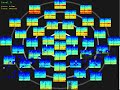
- This array of videos shows spectrographic data (representing brain wave frequencies) from each of 44 electrodes attached to the scalp of a healthy volunteer undergoing propofol anesthesia. The spectrograms are arranged according to their approximate position on the scalp, with the front of the head at the top of the screen, and the back of the head at the bottom of the screen. Activity moves from back to front with loss of consciousness (levels 1 to 5) and from back to front with return of consciousness (levels 6 to 8). Each video shows brain activity throughout a 140-minute period of the study. Video by Aylin Cimenser. Reproduced from PNAS with permission.
Read more: http://web.mit.edu/newsoffice/2013/how-the-brain-loses-and-regains-consciousness-0304.html
- Title
- MIT-developed coating could prevent frost buildup
- Runtime
- 1:10
- Date posted
- 14 years ago
- Description
- Preventing glass from fogging or frosting up is a longstanding challenge with myriad applications: eyeglasses, cameras, microscopes, mirrors and refrigerated displays, to name but a few. While there have been many advances in meeting this challenge, so far there has been no systematic way of testing different coatings and materials to see how effectively they work under real-world conditions.
Now, a team of MIT researchers has developed such a testing method, and used it to find a coating that outperforms others not only in preventing foggy buildups, but also in maintaining good optical properties without distortion.
Find out more: http://web.mit.edu/newsoffice/2013/antifogging-glass-coating-0305.html
Video: Melanie Gonick, MIT News
Experiment clip courtesy of: Hyomin Lee

- Title
- MIT teaches robots to adapt
- Runtime
- 1:01
- Date posted
- 14 years ago
- Description
- Most commercial robotic arms perform what roboticists call "pick and place" tasks: The arm picks up an object in one location and places it in another. General-purpose household robots, however, would have to be able to manipulate objects of any shape, left in any location. And today, commercially available robots don't have anything like the dexterity of the human hand.
At this year's IEEE International Conference on Robotics and Automation, the premier robotics conference, students in the Learning and Intelligent Systems Group at MIT's Computer Science and Artificial Intelligence Laboratory will present a pair of papers showing how household robots could use a little lateral thinking to compensate for their physical shortcomings.
Here we see MIT senior Annie Holladay demonstrate and describe how her algorithm helps the robot adapt by using both of its arms instead of just one.
Find out more about the research: http://web.mit.edu/newsoffice/2013...

- Title
- Scanning droplets
- Runtime
- 1:29
- Date posted
- 14 years ago
- Description
- Learn more about this research at http://web.mit.edu/newsoffice/2013/droplet-surface-adhesion-0219.html
Animated video depicts the way a movable stage inside the Scanning Electron Microscope (SEM) moves to change the angle of the surface, and a wire (curved gray cylinder) that can be used to push and pull a droplet over the surface.
Sequences of high-resolution images captured using the SEM show how the base of a water droplet forms small "necks" as it moves across a surface that has pillars etched on it to increase its water-shedding properties. These necks control the adhesion of the drop to the surface, and are important in designing superhydrophobic (water-repellent) materials.
Video: Adam Paxson and Kripa Varanasi

- Title
- Imaging Zebrafish at MIT
- Runtime
- 0:26
- Date posted
- 14 years ago
- Description
- MIT researchers have invented a new imaging system that allowed them to create this three-dimensional rendering of the cartilage that forms the skull of a five-day-old zebrafish larva. The total size of the skull is about 1 millimeter long.
Read more: http://web.mit.edu/newsoffice/2013/research-update-imaging-fish-in-3d-0212.html
Images by: Carlos Pardo

- Title
- MIT's Laboratory for Chocolate Science
- Runtime
- 4:21
- Date posted
- 14 years ago
- Description
- Founded in 2003, the MIT Laboratory for Chocolate Science is a student club dedicated to the appreciation of chocolate in all its myriad forms. The club hosts tastings, truffle-making seminars, lectures of fair trade, scientific demonstrations and numerous other events involving the enjoyment of and indulgence in all things chocolate.
Learn more about LSC: http://chocolate.mit.edu/
Video: Melanie Gonick, MIT News

- Title
- MIT's Annual Cardboard Boat Regatta
- Runtime
- 6:01
- Date posted
- 14 years ago
- Description
- The Head of the Zesiger is an annual event where participants are require to build a boat out of cardboard to complete the course laid out before them at MIT's Zesiger Center pool. The participants can only use cardboard, paper tape and paint - that's it.
There is a course available for credit to students over MIT's Independent Activities Period (IAP) which meets three times over the month of January leading up to the main event.
To learn more about the Head of the Zesiger: http://mitrecsports.com/index.php/aquatics/head-of-the-zesiger
Video: Melanie Gonick, MIT News

- Title
- Water-repellent surfaces that last
- Runtime
- 0:30
- Date posted
- 14 years ago
- Description
- In the first part of this video, the effects of condensation on three different surfaces are compared: On the left, a bare silicon surface, showing how water droplets remain "pinned" in place as they get bigger and bigger; in the center and right panels, two different rare-earth oxide ceramic surfaces, cerium oxide and erbium oxide, show how the droplets do not stick and instead are rapidly shed from the surface, increasing the efficiency of the condensation process.
In the second part, a rare-earth oxide surface that has been patterned to increase its water-repelling qualities, as shown on the left, causes a water droplet to simply bounce away, rather than sticking to the surface and spreading out.
Video: Gisele Azimi, Rajeev Dhiman, Hyuk-Min Kwon and Adam Paxon
Read more: http://web.mit.edu/newsoffice/2013/ceramic-hydrophobic-materials-0120.html
- Title
- Delivering large molecules to cells through tiny holes in membranes
- Runtime
- 0:13
- Date posted
- 14 years ago
- Description
- Living cells are surrounded by a membrane that tightly regulates what gets in and out of the cell. This barrier is necessary for cells to control their internal environment, but it makes it more difficult for scientists to deliver large molecules such as genes that can reprogram them into pluripotent stem cells, or nanoparticles for imaging.
Researchers from MIT have now found a safe and efficient way to get large molecules through the cell membrane, by squeezing the cells through a narrow constriction that opens up tiny, temporary holes in the membrane. Any large molecules floating outside the cell, such as DNA or proteins, can slide through the membrane during this disruption.
Using this technique, the researchers were able to deliver reprogramming proteins and generate induced pluripotent stem cells with a success rate 10 to 100 times better than any existing method. They also used it to deliver nanoparticles including carbon nanotubes and quantum dots, wh...

- Title
- Artificial muscles at MIT
- Runtime
- 1:20
- Date posted
- 14 years ago
- Description
- MIT researchers at the David H. Koch Institute for Integrative Cancer Research have developed a new material that changes its shape after absorbing water vapor.
This material is made from an interlocking network of two different polymers. One forms a hard but flexible matrix that provides structural support while the other is a soft gel that swells when it absorbs water. Together these polymers create a material that converts water vapor to energy without the use of an external energy source.
When the 20-micrometer-thick film is exposed to moisture the bottom layer absorbs the evaporated water, forcing the film to curl away from the surface. Once the bottom of the film is exposed to the air, it quickly releases the moisture causing it to somersault forward and start to curl up once more. Researchers were surprised to discover not only does it need a very small amount of vapor, but it also demonstrated a large amount of strength. Using only water vapo...
- Title
- Stopping a leak the way blood does
- Runtime
- 4:36
- Date posted
- 14 years ago
- Description
- When you get a cut, blood starts to flow from the wound. But very quickly, complex biochemical processes spring into action, creating a scaffolding of molecules to block the hole, and then building up an impervious clot to stanch the flow.
That process relies on a set of molecules that constantly flow through the body's veins and arteries, just waiting to spring into action when needed. When their job is done, they dissolve back into the blood, awaiting their next repair job.
A team of MIT researchers has analyzed the process and found, for the first time, exactly how the different molecular components work together to block the flow of blood from a cut. Now, they are working on applying that knowledge to the development of synthetic materials that could be used to control different kinds of liquid flows, and could lead to a variety of new self-assembling materials.
Read more: http://web.mit.edu/newsoffice/2013/how-to-stop-leaks-the-way-blood-doe...

- Title
- Jumping water droplets improve power-plant efficiency
- Runtime
- 1:53
- Date posted
- 14 years ago
- Description
- The efficiency of most industrial plants depends crucially on water vapor condensing on metal plates or condensers, and how easily the condensed water can fall away allowing for more droplets to form. On a typical, flat-plate condenser, water vapor condenses to form a liquid film on the surface, drastically reducing the condenser's ability to collect more water, and ultimately acting as a barrier to heat transfer.
By creating hydrophobic surfaces, either through chemical treatment or through surface patterning, researchers have been able to prevent this problem by encouraging water droplets to form and fall away. Now a team of MIT researchers have taken this process a step further by making surfaces that are patterned at multiple scales.
A group from MIT's mechanical engineering department found that the energy, released as tiny droplets of water that merge to form larger ones, is enough to propel the droplets upward from the surface. The removal of droplets...

- Title
- MIT gives back to the community
- Runtime
- 3:55
- Date posted
- 14 years ago
- Description
- Toys-for-Tickets and Fill-a-Cruiser, are just two of the ways MIT gives back to the community each year.
Toys-for-Tickets is a program that allows people to bring in a toy of equal value or more of their parking violation, and it will be forgiven. You can also get ID's and fingerprints done at this time for an exchange of a gift. Just don't forget your receipt!
Fill-a-Cruiser takes place one day on campus at two different locations. Anyone can come down and donate clothes, blankets, socks, hats, sheets or even cash! At the end of the day everything is stuffed into a MIT Police cruiser and driven down to the Salvation Army in Central Square, Cambridge.
Video: Melanie Gonick, MIT News

- Title
- MIT News at Noon with Burcu Erkmen
- Runtime
- 13:00
- Date posted
- 14 years ago
- Description
- Burcu Erkmen, a graduate student in the Harvard-MIT Health Sciences and Technology program, delivers her "News at Noon" talk at the MIT Museum. The event is co-sponsored by the MIT News Office and the Museum, and features researchers discussing their recently promoted work.
On Dec. 7, Berkmen discussed her research with Professors Utkan Demirci and Ed Boyden in developing 3-D brain tissue constructs. On the way to accomplishing this complex task, Erkmen and team adapted multiple layer photolithography to precisely build tissue structures only microns in size.
Presenters for "News at Noon" are announced each week following an appearance in MIT News. Come and connect with local colleagues before and after the program. Free admission to all. Learn more at http://web.mit.edu/museum/pdf/MITNewsAtNoon-F12.pdf
Read more about this research at http://web.mit.edu/newsoffice/2012/precisely-engineering-3d-brain-tissues-1130.html
Learn about the...
- Title
- The Tech Model Railroad Club of MIT
- Runtime
- 4:55
- Date posted
- 14 years ago
- Description
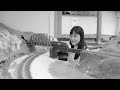
- Tucked deep within MIT's campus is a miniature world of model trains, elaborate miniature buildings and detailed sceneries. Now entering its 65th year, Tech Model Railroad Club of MIT (TMRC) still caters to model railroaders, rail-fans and hackers alike.
In this video we take a tour of the layout and the history through the eyes of club members Quentin Smith, Rebecca Perry and John Macnamara.
TMRC: http://tmrc.mit.edu/
Video: Melanie Gonick
Still Images: MIT Museum
Special thank you to Angela Saini for extra footage and inspiration.

- Title
- MIT News at Noon with Neil Gershenfeld and Ara Knaian
- Runtime
- 18:15
- Date posted
- 14 years ago
- Description
- Neil Gershenfeld, Director of the Center for Bits and Atoms, and visiting scientist Ara Knaian, deliver their"News at Noon" talk at the MIT Museum. The event is co-sponsored by the MIT News Office and the Museum, and features researchers discussing their recently promoted work.
On Nov. 30, Gershenfeld and Knaian discussed their robot, the Milli-Motein, which is not only one of the world's smallest robots, but if can also reconfigure itself in a matter of seconds.
Presenters for "News at Noon" are announced each week following an appearance in MIT News. Come and connect with local colleagues before and after the program. Free admission to all. Learn more at http://web.mit.edu/museum/pdf/MITNewsAtNoon-F12.pdf
Read more about Milli-Motein at http://web.mit.edu/newsoffice/2012/reconfigurable-robots-turn-into-anything-1130.html
Learn about the MIT Museum at http://web.mit.edu/museum/
Video: MIT Video Productions/AMPS; MIT New...
- Title
- (Tiny) Reconfigurable Robots at MIT
- Runtime
- 3:13
- Date posted
- 14 years ago
- Description
- The device doesn't look like much: a caterpillar-sized assembly of metal rings and strips resembling something you might find buried in a home-workshop drawer. But the technology behind it, and the long-range possibilities it represents, are quite remarkable.
The little device is called a milli-motein — a name melding its millimeter-sized components and a motorized design inspired by proteins, which naturally fold themselves into incredibly complex shapes. This minuscule robot may be a harbinger of future devices that could fold themselves up into almost any shape imaginable.
The device was conceived by Neil Gershenfeld, head of MIT's Center for Bits and Atoms, visiting scientist Ara Knaian and graduate student Kenneth Cheung, and is described in a paper presented recently at the 2012 Intelligent Robots and Systems conference. Its key feature, Gershenfeld says: "It's effectively a one-dimensional robot that can be made in a continuous strip, without conventi...

- Title
- MIT News at Noon with Missy Cummings
- Runtime
- 20:57
- Date posted
- 14 years ago
- Description
- Missy Cummings, associate professor of aeronautics and astronautics and engineering systems at MIT, delivers her "News at Noon" talk at the MIT Museum. The event is co-sponsored by the MIT News Office and the Museum, and features researchers discussing their recently promoted work.
On Nov. 16, Cummings discussed how boredom plays a major role in a drone-operators ability to do their job. Her study found that UAV operators tend to preform better with a little distraction.
Presenters for "News at Noon" are announced each week following an appearance in MIT News. Come and connect with local colleagues before and after the program. Free admission to all. Learn more at http://web.mit.edu/museum/pdf/MITNewsAtNoon-F12.pdf
Read more about Cumming's work at http://web.mit.edu/newsoffice/2012/boredom-and-unmanned-aerial-vehicles-1114.html
Learn about the MIT Museum at http://web.mit.edu/museum/
Video: MIT Video Productions/AMPS; MI...

- Title
- Spider silk makes music at MIT
- Runtime
- 4:04
- Date posted
- 14 years ago
- Description
- Pound for pound, spider silk is one of the strongest materials known: Research by MIT's Markus Buehler has helped explain that this strength arises from silk's unusual hierarchical arrangement of protein building blocks.
Now Buehler — together with David Kaplan of Tufts University and Joyce Wong of Boston University — has synthesized new variants on silk's natural structure, and found a method for making further improvements in the synthetic material.
And an ear for music, it turns out, might be a key to making those structural improvements.
Read more: http://web.mit.edu/newsoffice/2012/the-music-of-the-silks-1128.html
Video: Melanie Gonick
Computer simulation with AAAB pattern or "More A": S. Rye and M. Buehler (video); E. Erenberg (flute), W. Kenlon (recording) and J. McDonald (composition; all three Tufts University).
Computer simulation with ABBB pattern or "More B": S. Rye and M. Buehler (video); E. Erenbe...

- Title
- Understanding Arctic Sea Ice at MIT
- Runtime
- 4:52
- Date posted
- 14 years ago
- Description
- Read more about Principal Research Scientist Patrick Heimbach's work in MIT's Department of Earth, Atmospheric and Planetary Sciences at MIT News: http://web.mit.edu/newsoffice/2012/ocean-currents-and-sea-ice-1121.html
The MITgcm website: http://mitgcm.org
And the website for NASA's ECCO2: http://ecco2.org
About the animation: The simulation was conducted with the MIT coupled ocean-sea ice general circulation model, or in short, MITgcm. The configuration was constructed as part of the Estimating the Circulation and Climate of the Ocean Phase II, or ECCO2 project. It was run by project partners Gunnar Spreen and Dimitris Menemenlis at NASA's Jet Propulsion Laboratory on NASA's supercomputer "Pleiades" at the Ames Research Center in Moffett Field, California. Tim Sandstrom at NASA's Advanced Supercomputing Division performed the visualization of the simulations.
Image Credits:
Earth System Research Laboratory, NOAA, http://...

- Title
- Happy Thanksgiving from MIT
- Runtime
- 3:53
- Date posted
- 14 years ago
- Description
- MIT students, administrators, and staff reflect on their Thanksgiving traditions, and what the holiday means at MIT. Happy Thanksgiving 2012!

- Title
- Spinning fibers at the nanoscale at MIT
- Runtime
- 1:12
- Date posted
- 14 years ago
- Description
- A team of MIT researchers has developed a new way to generate nanofibers, using hardware built through standard chip-manufacturing processes. In their prototype, the researchers cram 25 emitters into a square centimeter, boosting nano fiber-production rates while reducing power consumption.
Read more:
Video clips courtesy of Luis Fernando Velazquez-Garcia

- Title
- Harnessing the Wind at MIT: Wright Brothers Wind Tunnel
- Runtime
- 6:14
- Date posted
- 14 years ago
- Description
- The Massachusetts Institute of Technology is home to the only privately owned and operated wind tunnel in the United States. Hidden in plain sight on MIT's campus, the Wright Brothers Wind Tunnel has proven instrumental in the examination of aerospace, architectural, vehicular, sports and other engineering systems.
Approaching its 75th year in use, we take a look back at how the tunnel and the research done within have evolved over the years and how it has become such an iconic part of the Institute.
Described by the people who know it best, the Wright Brothers Wind Tunnel is a vital part of the Department of Aeronautics and Astronautics and according to most students, the heart of MIT.
Wright Brothers Wind Tunnel: http://web.mit.edu/aeroastro/labs/wbwt/
Department of Aeronautics and Astronautics: http://aeroastro.mit.edu/
Video: Melanie Gonick
Still images courtesy of the MIT Museum and MIT AeroAstro

- Title
- How nutrients spread in a turbulent sea
- Runtime
- 0:13
- Date posted
- 14 years ago
- Description
- A computer simulation -- part of Associate Professor of Civil and Environmental Engineering Roman Stocker and former MIT post-doc John R. Taylor's work -- shows the way a patch of nutrient material is pulled apart into swirling filaments by turbulence in the water, eventually dissolving away completely. The process is similar to the way cream in a cup of coffee first forms swirls, then eventually is uniformly distributed through the coffee.
Read more at MIT News: http://web.mit.edu/newsoffice/2012/microbes-sit-still-or-go-hunting-for-food-1101.html

- Title
- On the hunt for rare cancer cells
- Runtime
- 0:35
- Date posted
- 14 years ago
- Description
- In the first part of this video, a particle covered with DNA strands that can bind to a protein found on cancer cells approaches a cell. Though the particle does not directly contact the cell, the DNA strands entangle the cell, as demonstrated when the particle is pulled away and the cell is pulled towards the particle.
In the second part, a particle covered with small molecules that target the same cancer protein does not achieve the same strong binding, even though it comes in direct contact with the cell.
Read more about this research at MIT News: http://web.mit.edu/newsoffice/2012/capturing-rare-cancer-cells-1112.html
Video by Wesley Wong, Harvard Medical School.

- Title
- MIT News at Noon: Devavrat Shah on Twitter trends
- Runtime
- 25:09
- Date posted
- 14 years ago
- Description
- Devavrat Shah, Associate Professor in the Development of Electrical Engineering & Computer Science, delivers his "News at Noon" talk at the MIT Museum. The event is co-sponsored by the MIT News Office and the Museum, and features researchers discussing their recently promoted work.
On Nov. 9, Shah discussed how he uses his machine-learning algorithm to predict trends hours in advance of recognition by Twitter.
Presenters for "News at Noon" are announced each week following an appearance in MIT News. Come and connect with local colleagues before and after the program. Free admission to all. Learn more at http://web.mit.edu/museum/pdf/MITNewsAtNoon-F12.pdf
Read more about Shah's work at http://web.mit.edu/newsoffice/2012/predicting-twitter-trending-topics-1101.html
Learn about the MIT Museum at http://web.mit.edu/museum/
Video: MIT Video Productions/AMPS; MIT News

- Title
- MIT News at Noon: Jeffrey Karp
- Runtime
- 25:02
- Date posted
- 14 years ago
- Description
- Jeffrey Karp, MIT HST faculty and co-director of the Center for Regenerative Therapeutics at Brigham and Women's Hospital, delivers his "News at Noon" talk at the MIT Museum. The event is co-sponsored by the MIT News Office and the Museum, and features researchers discussing their recently promoted work.
On Nov. 2, Karp discussed his team's new medical adhesive that is safe enough for an infant's delicate skin.
Presenters for "News at Noon" are announced each week following an appearance in MIT News. Come and connect with local colleagues before and after the program. Free admission to all. Learn more at http://web.mit.edu/museum/pdf/MITNewsAtNoon-F12.pdf
Read more about Karp's work at http://web.mit.edu/newsoffice/2012/new-medical-tape-for-sensitive-skin-1029.html
Learn about the MIT Museum at http://web.mit.edu/museum/
Video: MIT Video Productions/AMPS; MIT News

- Title
- The Listening Room - MIT's Music Program
- Runtime
- 6:50
- Date posted
- 14 years ago
- Description
- Visit The Listening Room at http://shass.mit.edu/listen
Of the nearly 4,000 undergraduates at MIT for the 2012-13 academic year, more than 1,800 are enrolled in a music or theater arts course. The Listening Room is an online collection that showcases the Institute's longstanding engagement with music — featuring music composed and performed by MIT students and by the Institute's internationally renowned Music faculty.
The Listening Room launched with 64 recordings organized in four musical categories — Classical, Jazz, World and Faculty Opus. The collection, which is accompanied by photographs, historical notes and comments from composers, will continue to grow steadily with regular additions of new compositions and performances from MIT's music groups, including the Festival Jazz Ensemble, Wind Ensemble, Chamber Music Society, Galak Tika, Chamber Chorus, Concert Chorus, Rambax, MIT Symphony Orchestra, and soloists from MIT's conservatory-level Emerson Sch...

- Title
- Deflecting an asteroid, with paintballs
- Runtime
- 0:53
- Date posted
- 14 years ago
- Description
- In the event that a giant asteroid is headed toward Earth, you'd better hope that it's blindingly white. A brightly colored asteroid would reflect sunlight — and over time, this bouncing of photons off its surface could create enough of a force to push the asteroid off its course.
How might one encourage such a deflection? The answer, according to an MIT graduate student: with a volley or two of space-launched paintballs.
Read more at MIT News: http://web.mit.edu/newsoffice/2012/deflecting-an-asteroid-with-paintballs-1026.html
- Title
- Felice Frankel on Visualizing Strategies
- Runtime
- 2:26
- Date posted
- 14 years ago
- Description
- Sometimes color helps. Sometimes it just gets in the way.
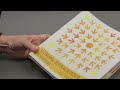
That's just one example of the lack of simple prescriptions for how to use visual materials to clearly communicate scientific concepts or research results. It all depends on the particulars, Felice Frankel explains patiently in seminars at MIT and in her new book, "Visual Strategies," published this fall by Yale University Press.
Read more at MIT News: http://web.mit.edu/newsoffice/2012/communicating-science-visually-felice-frankel-1026.html

- Title
- Neuron imaging at MIT
- Runtime
- 1:46
- Date posted
- 14 years ago
- Description
- A team led by MIT neuroscientists has developed a way to monitor how brain cells coordinate with each other to control specific behaviors, such as initiating movement or detecting an odor. The researchers' new imaging technique, based on the detection of calcium ions in neurons, could help them map the brain circuits that perform such functions. It could also provide new insights into the origins of autism, obsessive-compulsive disorder and other psychiatric diseases says Guoping Feng, the James W. and Patricia Poitras Professor of Neuroscience and a member of the McGovern Institute for Brain Research at MIT.
Video: Melanie Gonick
Simulations/extra footage: McGovern Institute for Brain Research at MIT/Sputnik Animation

- Title
- Seeing the light with MIT's Christoph Reinhart
- Runtime
- 2:17
- Date posted
- 14 years ago
- Description
- Check out the Cambridge Solar Map: http://www.cambridgema.gov/solar
And read the profile of Associate Professor Christoph Reinhart in MIT's Department of Architecture on MIT News: http://web.mit.edu/newsoffice/2012/faculty-profile-reinhart-1015.html
- Title
- Drawing carbon nanotubes on paper at MIT
- Runtime
- 2:31
- Date posted
- 14 years ago
- Description
- Carbon nanotubes offer a powerful new way to detect harmful gases in the environment. However, the methods typically used to build carbon nanotube sensors are hazardous and not suited for large-scale production.
A new fabrication method created by MIT chemists — as simple as drawing a line on a sheet of paper — may overcome that obstacle. MIT postdoc Katherine Mirica has designed a new type of pencil lead in which graphite is replaced with a compressed powder of carbon nanotubes. The lead, which can be used with a regular mechanical pencil, can inscribe sensors on any paper surface.
The sensor, described in the journal Angewandte Chemie, detects minute amounts of ammonia gas, an industrial hazard. Timothy Swager, the John D. MacArthur Professor of Chemistry and leader of the research team, says the sensors could be adapted to detect nearly any type of gas.
Read more:
Video: Melanie Gonick
Simulations courtesy of: Jan Schnorr

- Title
- In Profile: MIT's Catherine Tucker
- Runtime
- 2:10
- Date posted
- 14 years ago
- Description
- Catherine Tucker, the Mark Hyman Jr. Career Development Associate Professor of Marketing at the MIT Sloan School of Management, discusses the intersection of her personal and professional lives.
Read more at http://web.mit.edu/newsoffice/2012/faculty-profile-tucker-sloan-1002.html

- Title
- Manipulating microscopic magnetic beads at MIT
- Runtime
- 0:39
- Date posted
- 14 years ago
- Description
- MIT researchers found that arc-shaped magnetic nanotracks could be used most effectively to control the motion of magnetic microbeads across the surface of a silicon wafer. By combining these arcs, they produced configurations such as this, with two "reservoir" rings at top right and left, where the beads can be stored indefinitely, connected to tracks where they can be moved along as needed. In the center, a junction allows the bead's path to be altered, either continuing to the side or moving downward to another section of the wafer. By combining such structures, complex series of manipulations of the beads could be carried out.
Read more at MIT News: http://web.mit.edu/newsoffice/2012/magnetic-beads-lab-on-a-chip-0925.html

- Title
- Automatic building mapping at MIT
- Runtime
- 2:07
- Date posted
- 14 years ago
- Description
- In a paper slated for the Intelligent Robots and Systems conference in Portugal next month, MIT researchers describe a wearable sensor system that automatically creates a digital map of the environment through which the wearer is moving. The prototype system is envisioned as a tool to help emergency responders coordinate disaster response.
Read more at MIT News http://web.mit.edu/newsoffice/2012/automatic-building-mapping-0924.html

- Title
- L. Rafael Reif: Laying the foundation
- Runtime
- 7:24
- Date posted
- 14 years ago
- Description
- A tribute video to MIT's 17th President, L. Rafael Reif, from the Microsystems Technology Laboratories (http://www-mtl.mit.edu/) at MIT.
Video by Greg Hren
- Title
- Getting (drugs) under your skin
- Runtime
- 1:25
- Date posted
- 14 years ago
- Description
- Using ultrasound waves, MIT engineers have found a way to enhance the permeability of the skin to drugs, making transdermal drug delivery more efficient. This technology could pave the way for noninvasive drug delivery or needle-free vaccinations, according to the researchers.
Read more at MIT News: http://web.mit.edu/newsoffice/2012/ultrasound-waves-and-drug-delivery-0914.html
- Title
- Chris Zegras - Transportation at MIT & around the world
- Runtime
- 3:26
- Date posted
- 14 years ago
- Description
- Read the profile of Chris Zegras, Associate Professor of Transportation and Urban Planning, on the MIT News site: http://web.mit.edu/newsoffice/2012/faculty-profile-chris-zegras-0913.html