Veritasium
How To Make a Quantum Bit

- Title
- How To Make a Quantum Bit
- Runtime
- 7:51
- Date posted
- 13 years ago
- Description
- How does a transistor work? https://www.youtube.com/watch?v=IcrBqCFLHIY
Silicon-28 sphere: http://bit.ly/10J1G2o
This episode supported by audible.com: http://bit.ly/ZJ5Q6z
We have looked at how a transistor works, the fundamental unit of classical computers, and how a quantum computer works in theory, taking advantage of quantum superposition to hold exponentially more information than classical computers. Now we look at the practical side of making a quantum bit, or qubit. How do you put it in a state where it is stable? How do you read and write information on it? These processes are described for a solid state qubit - a phosphorous atom in a silicon crystal substrate. Both the electron and the nucleus of the phosphorous atom can be used as qubits.
Thanks to A/Prof. Andrea Morello: http://bit.ly/17wZ7lt
Thanks to Henry Reich (MinutePhysics) for pushing me to make the explanations and visualizations clearer.

- Title
- How Does a Transistor Work?
- Runtime
- 6:00
- Date posted
- 13 years ago
- Description
- How does a transistor work? Our lives depend on this device.
Support Veritasium on Patreon: http://bit.ly/VePatreon
Subscribe to Veritasium - it's FREE! http://bit.ly/YSWpWm
When I mentioned to people that I was doing a video on transistors, they would say "as in a transistor radio?" Yes! That's exactly what I mean, but it goes so much deeper than that. After the transistor was invented in 1947 one of the first available consumer technologies it was applied to was radios, so they could be made portable and higher quality. Hence the line in 'Brown-eyed Girl' - "going down to the old mine with a transistor radio."
But more important to our lives today, the transistor made possible the microcomputer revolution, and hence the Internet, and also TVs, mobile phones, fancy washing machines, dishwashers, calculators, satellites, projectors etc. etc. A transistor is based on semiconductor material, usually silicon, which is 'doped' with impurities to carefu...

- Title
- Can We Really Touch Anything?
- Runtime
- 8:25
- Date posted
- 13 years ago
- Description
- Can we really touch things? Well if by touch we mean exchange a force-carrying particle with, then yes. The photon is the force-carrier of the electromagnetic interaction. But if the photon is also a particle of light then why aren't magnets glowing? Because the photons are virtual particles, which means they can't be directly detected (without changing the outcome we are trying to measure.
Supported by Audible: http://bit.ly/ZJ5Q6z
Who would win in a chin-up competition between me and MinutePhysics? What is going to be the most exciting area of scientific discovery in the next few decades? Where can you get a Veritasium t-shirt? http://dft.ba/-vetshirt
Huge thanks to Brady, CGP Grey, and Henry for their cameos.
Thank you to PhET for the Bohr model simulation: http://phet.colorado.edu/

- Title
- How Does a Quantum Computer Work?
- Runtime
- 6:47
- Date posted
- 13 years ago
- Description
- For more on spin, check out: http://youtu.be/v1_-LsQLwkA
This video was supported by TechNYou: http://bit.ly/19bBX5G
A quantum computer works in a totally different way from a classical computer. Quantum bits or 'qubits' can exist in a superposition state of both zero and one simultaneously. This means that a set of two qubits can be in a superposition of four states, which therefore require four numbers to uniquely identify the state. So the amount of information stored in N qubits is two to the power of N classical bits.
Thank you to Andrea Morello and UNSW. For more info, check out: http://bit.ly/17wZ7lt

- Title
- Do Aliens Exist?
- Runtime
- 6:36
- Date posted
- 14 years ago
- Description
- Subscribe to Veritasium - it's FREE! http://bit.ly/YSWpWm
Check out other unanswered science questions: http://youtu.be/UFydagCS9fg
The universe is huge. That means two things: 1. there is probably life elsewhere, 2. It is likely too far away to have reached us.
Fast, Furious & Funny - http://www.youtube.com/fastfuriousand... (http://www.youtube.com/watch?v=YWxub2...)
The Brain Scoop - http://www.youtube.com/thebrainscoop (http://youtu.be/mNuu0y6ZmAs)
ASAPScience - http://www.youtube.com/AsapSCIENCE (http://www.youtube.com/watch?v=wgxJhp...)
The Royal Institute of Great Britain - http://www.youtube.com/TheRoyalInstit... (http://www.youtube.com/watch?v=gm02Oi...)
PBS Idea Channel - http://www.youtube.com/pbsideachannel (http://www.youtube.com/watch?v=TbNymw...)
The Spangler Effect - http://www.youtube.com/TheSpanglerEffect (http://www.youtube.com/watch?v=4fQ4uB...)
Minute Physi...

- Title
- Why the Sky ISN'T Blue
- Runtime
- 7:53
- Date posted
- 14 years ago
- Description
- I actually have many, many more questions and answers so if you want to see them, like this video and let me know in the comments and I will edit them. Thank you for your support! I wouldn't have gotten this far without you.

- Title
- Your Mass is NOT From the Higgs Boson
- Runtime
- 6:51
- Date posted
- 14 years ago
- Description
- The Higgs Boson is awesome but it's NOT responsible for most of your mass! Thanks to audible.com for supporting this episode: http://bit.ly/ZJ5Q6z
The Higgs mechanism is meant to account for the mass of everything, right? Well no, only the fundamental particles, which means that electrons derive their mass entirely from the Higgs interaction but protons and neutrons, made of quarks, do not. In fact the quark masses are so small that they only make up about 1% of the mass of the proton (and a similar fraction of the neutron). The rest of the mass comes from the energy in the gluon field. Gluons are massless, but there is so much energy in the field that by E=mc^2 there is a significant amount of mass there. This is where most of your mass comes from and the mass of virtually everything around you.
Thanks to Professor Derek Leinweber for his great images, animations and explanations. Check out his site to find out more: http://bit.ly/ZZTKFP

- Title
- Empty Space is NOT Empty
- Runtime
- 4:46
- Date posted
- 14 years ago
- Description
- An atom is mostly empty space, but empty space is mostly not empty. The reason it looks empty is because electrons and photons don't interact with the stuff that is there, quark and gluon field fluctuations.
It actually takes energy to clear out space and make a true 'empty' vacuum. This seems incredibly counter-intuitive but we can make an analogy to a permanent magnet. When at low energies, like at room temperature, there is a magnetic field around the magnet due to the alignment of all the magnetic moments of the atoms. But if you add some energy to it by heating it, the particles gain thermal energy, which above the Curie temperature makes their magnetic moments randomly oriented and hence destroying the magnetic field. So in this case energy is needed to clear out the field, just as in the quantum vacuum.
Special thanks to Professor Derek Leinweber, find out more about his research here: http://bit.ly/ZZTKFP

- Title
- The Science of Jetpacks and Rockets!
- Runtime
- 8:37
- Date posted
- 14 years ago
- Description
- Check out 2Veritasium! https://ve42.co/2Ve
MinutePhysics has a great video on Milkman, vomiting levitator: http://dft.ba/-vomphysics
Jetpacking was awesome fun! Despite the fat lip I had a great time. I think knowing a bit about physics actually helps fly the jetpack. It works on the same principle as a rocket (Newton's 3rd law) but unlike the shuttle, you don't carry your own propellant with you. Instead, water is pumped out of the lake by the jetski at up to 60 litres a second. It is then fired out of the nozzles at around 15 m/s creating 1800 N of force, the equivalent of about 150 fire extinguishers. On me this can produce acceleration of about 1.5g's.
Music by Kevin McLeod (http://incompetech.com) Silly Fun, Also Sprach Zarathustra
Supported by Science Alert: http://on.fb.me/14ehuxA
Slow motion filming by Questacon: http://bit.ly/ZoWFGR

- Title
- Epic Slow-Mo Drum Implosions!
- Runtime
- 6:53
- Date posted
- 14 years ago
- Description
- Negative Pressure Exists! http://bit.ly/TFilQ8
Vsauce's Space Straw: http://bit.ly/XubIm3
Smarter Every Day's Prince Rupert's Drop: http://bit.ly/10VQBGW
ViHart's Optimal Potatoes: http://bit.ly/14egJoe
Thanks to Questacon for filming! Check out their slow-mo playlist: http://bit.ly/ZoWFGR
Science Alert brings science to your news feed: http://on.fb.me/14ehuxA
Music by Kevin Mcleod (http://incompetech.com): Pale Rider & The Cannery

- Title
- World's Roundest Object!
- Runtime
- 11:44
- Date posted
- 14 years ago
- Description
- The world's roundest object helps solve the longest running problem in measurement -- how to define the kilogram.
Support Veritasium on Patreon: http://bit.ly/VePatreon
A kilogram isn't what it used to be. Literally. The original name for it was the 'grave', proposed in 1793 but it fell victim to the French Revolution like its creator, Lavoisier. So begins the tale of the most unusual SI unit. The kilogram is the only base unit with a prefix in its name, and the only one still defined by a physical artifact, the international prototype kilogram or IPK.
But the problem with this definition has long been apparent. The IPK doesn't seem to maintain its mass compared to 40 similar cylinders minted at the same time. The goal is therefore to eliminate the kilogram's dependence on a physical object. Two main approaches are being considered to achieve this end: the Avogadro Project and the Watt Balance.
The Avogadro project aims to redefine Avogadro'...

- Title
- Single Photon Interference
- Runtime
- 6:00
- Date posted
- 14 years ago
- Description
- What happens when single photons of light pass through a double slit and are detected by a photomultiplier tube? In 1801 Thomas Young seemed to settle a long-running debate about the nature of light with his double slit experiment. He demonstrated that light passing through two slits creates patterns like water waves, with the implication that it must be a wave phenomenon.
However, experimental results in the early 1900s found that light energy is not smoothly distributed as in a classical wave, rather it comes in discrete packets, called quanta and later photons. These are indivisible particles of light. So what would happen if individual photons passed through a double slit? Would they make a pattern like waves or like particles?

- Title
- What Can Frogs See That We Can't?
- Runtime
- 3:05
- Date posted
- 14 years ago
- Description
- Check out the original double slit experiment: http://www.youtube.com/watch?v=Iuv6hY6zsd0 - oh, and for the sun to be seen as single photons, you would have to be ~1000 light years away, so well past Pluto. For clarification on this video, please see: http://www.youtube.com/watch?v=OW7tfrTh66c
What would you see if you were drifting through space, looking back at the sun? Well its light intensity would decrease as the inverse square of distance from the sun. And you would imagine the intensity would decrease smoothly, asymptotically approaching zero.
But this is not what happens.
If you had sensitive enough eyes, like frogs' eyes, you would find that at some point the sun would start to flicker. You would see flashes of light separated by complete darkness. And as you drift further from the sun, what's strange is that these flashes do not decrease in brightness, but they do become less frequent. That's because light comes in lumps, called quanta or photo...

- Title
- The Original Double Slit Experiment
- Runtime
- 7:40
- Date posted
- 14 years ago
- Description
- Light is so common that we rarely think about what it really is. But just over two hundred years ago, a groundbreaking experiment answered the question that had occupied physicists for centuries. Is light made up of waves or particles?
The experiment was conducted by Thomas Young and is known as Young's Double Slit Experiment. This famous experiment is actually a simplification of a series of experiments on light conducted by Young. In a completely darkened room, Young allowed a thin beam of sunlight to pass through an aperture on his window and onto two narrow, closely spaced openings (the double slit). This sunlight then cast a shadow onto the wall behind the apparatus. Young found that the light diffracted as it passed through the slits, and then interfered with itself, created a series of light and dark spots. Since the sunlight consists of all colours of the rainbow, these colours were also visible in the projected spots. Young concluded that light consist of waves an...

- Title
- Veritasium Trailer
- Runtime
- 0:30
- Date posted
- 14 years ago
- Description
- Veritasium is a channel of science and engineering videos featuring experiments, expert interviews, cool demos, and discussions with the public about everything science.
Clips featured in this video:
Trees are Freaking Awesome - http://bit.ly/TFilQ8
Gyroscopic Precession - http://bit.ly/U4e8HQ
Can We Go The Speed of Light? (Principle of Relativity) - http://bit.ly/X1BlXZ
Where Does The Sun Get Its Energy? - http://bit.ly/125jbeM
Where Do Trees Get Their Mass? - http://bit.ly/11AA817
What Is A Candle Flame Made Of? - http://bit.ly/Q3enCb
Levitating Barbecue (Electromagnetic Induction) - http://bit.ly/SWgOWh
Imploding Drum - http://bit.ly/125jG8B
Microwave Grape Plasma - http://bit.ly/QkCwUt
Spinning Tube Trick - http://bit.ly/Va43Z6
Spinning Disk Trick - http://bit.ly/14MSKsT
Why Do You Make People Look Stupid? - http://bit.ly/12Fmlpl
Awesome HD Slinky Slow-Mo - http://bit.ly/TRa4sE
Subscribe to Ve...

- Title
- Why Do Venomous Animals Live In Warm Climates?
- Runtime
- 11:40
- Date posted
- 14 years ago
- Description
- As a Canadian-Australian, I have always wondered why it is that Australia has so many venomous animals that can kill you while Canada has virtually none.
Subscribe to Veritasium - it's free! http://bit.ly/YSWpWm
But it's not just Australia - it seems like all beautiful, warm places are cursed with venomous native species. So I set out to find the truth: why have all these venomous species evolved in the world's best holiday destinations?
I asked chemists, visited the zoo, interviewed entomologists and snake experts. The answer I found was complicated:
1. The majority of venomous species are ectotherms, cold-blooded creatures whose internal temperatures are governed by their surroundings.
2. This means they have limited periods of activity - mainly while it's warm out, and can only exert short bursts of energy, so they are generally "sit and wait" predators. This may explain why they, more than mammals or birds, evolved venom.
3. ...

- Title
- How To Make Colour With Holes
- Runtime
- 5:38
- Date posted
- 14 years ago
- Description
- Scientists are being inspired by nature to design the next generation of security devices. Arrays of nanoscale holes create beautiful reflected colours that are almost impossible to forge. This video was supported by TechNyou - check out their series on logical fallacies: http://bit.ly/WBsD31
Soon these nanoscale security devices could replace holograms. They are many times more reflective than holograms, and although the structures are smaller scale, they are lower aspect ratio and therefore easy to manufacture in bulk.
The electron wiggle simulation is from PhET, the best physics simulations ever: http://phet.colorado.edu
Special thanks to Thomas from Copenhagen who showed me around the city including the science museum where he assisted with the soap bubble demonstration.
Clint Landrock is the Chief Technology Officer for Nanotech Securities: http://www.nanosecurity.ca
Music is "Firefly in a Fairytale" by Gareth Coker
- Title
- Heisenberg's Uncertainty Principle Explained
- Runtime
- 4:12
- Date posted
- 14 years ago
- Description
- Heisenberg's uncertainty principle tells us that it is impossible to simultaneously measure the position and momentum of a particle with infinite precision. In our everyday lives we virtually never come up against this limit, hence why it seems peculiar. In this experiment a laser is shone through a narrow slit onto a screen. As the slit is made narrower, the spot on the screen also becomes narrower. But at a certain point, the spot starts becoming wider. This is because the photons of light have been so localised at the slit that their horizontal momentum must become less well defined in order to satisfy Heisenberg's uncertainty principle.
I based this video on one by Prof. Walter Lewin of MIT: http://bit.ly/100Wk2K
Henry (MinutePhysics) has previously made a video about Heisenberg's Uncertainty Principle where he treats it as less spooky and more a consequence of waves: http://bit.ly/TV3xO5
Sixty Symbols has a great video on Planck's constant: h...
- Title
- What Could Survive An Atomic Bomb?
- Runtime
- 2:07
- Date posted
- 14 years ago
- Description
- I am nearing the end of a 6-week road trip filming for an Australian TV show called Catalyst (http://abc.net.au/catalyst). Along with co-presenters Anja and Simon, I have travelled from Perth towards our destination, Melbourne, picking up all the interesting science stories along the way.
Since we have been working long days I haven't had time to make any new Veritasium material. Instead I thought I'd share some things I have done for this show in the past, including narrating short 'factoid' segments like this one. Hope everyone is having a great holiday season and I look forward to getting back to Veritasium stuff in a few weeks.
Nuclear Fungus
Producer: Nicky Ruscoe
Researcher: Kiri Beilby
Editor: Chris Spur
Graphics: Rapt Animation P/L
http://abc.net.au/catalyst

- Title
- Paralysed Rats Made To Walk Again
- Runtime
- 6:34
- Date posted
- 14 years ago
- Description
- Innovative research conducted in Lausanne, Switzerland has shown that a combination of neurotransmitters and electrical stimulation can restore movement to the lower limbs of previously paralysed rats. But in order for this motion to be made voluntarily the rats must be motivated to walk. This motivation comes in the form of cheering, visual cues, and of course, chocolate.
Why Trees Are Amazing: http://bit.ly/TFilQ8
Space Junk: http://bit.ly/XlLdjG
Why Astronauts Are Weightless: http://bit.ly/SuF2p1
Higgs Boson Update: http://bit.ly/Vw1Sgu

- Title
- How To Clean Up Space Junk
- Runtime
- 6:08
- Date posted
- 14 years ago
- Description
- Space junk is a real problem. NASA now tracks around 20,000 pieces of debris orbiting Earth, most of them larger than 10cm across. Since the average speed of a collision between orbiting objects is 10 km/s these pieces of trash can cause a lot of damage despite their small size.
Scientists in Switzerland have a plan to clean up space junk - it involves creating a 'Janitor Satellite' that will seek out pieces of space junk to drag back into the atmosphere causing them to burn up.
This video was created for the Aussie science show Catalyst on the ABC: http://www.abc.net.au/catalyst

- Title
- Corn Flour Fireball
- Runtime
- 3:05
- Date posted
- 14 years ago
- Description
- Corn flour blown through a funnel produces an excellent fireball. This both looks cool and demonstrates some interesting science. In any chemical reaction, the reactants must mix with each other significantly in order to increase the rate of reaction. Here we demonstrate that corn flour on a spoon burns slowly, but blown from a funnel, the reaction is dramatic and violent. This is because the surface area where the reaction can occur is greatly increased.
HD Slinky Slow-mo http://bit.ly/TRa4sE
How to make solid nitrogen http://bit.ly/RqPw8l
Levitating BBQ http://bit.ly/SWgOWh
Electric Flame http://bit.ly/Q3enCb
As always, if you are planning to recreate this experiment, make sure you have appropriate supervision and take necessary precautions.

- Title
- World's First Electric Generator
- Runtime
- 3:49
- Date posted
- 14 years ago
- Description
- Huge thanks to the Royal Institution, Professor Frank James, and Katie Atmore for filming.
For the Sixty Symbols version of this experiment click http://bit.ly/RGfLY5
Michael Faraday created the first electric generator in 1831 using a coil of wire and a permanent magnet. When the magnet was moved relative to the coil, current was induced in the coil. A similar experiment can be performed with a copper tube and a magnet. Although copper is not magnetic, it is a conductor. As the magnet falls through the pipe, the magnetic field changes over different sections of the pipe. This induces swirling currents (called eddy currents), which create a magetic field that opposes the motion of the magnet. This means work must be done to move the magnet through the pipe. This work generates the electrical energy, which is then dissipated as thermal energy in the pipe. The same basic principle is used to generate electricity throughout the world: moving a magnet inside copper coils...
- Title
- How Trees Bend the Laws of Physics
- Runtime
- 7:23
- Date posted
- 14 years ago
- Description
- Hope this was worth the wait! So many people helped with this video: Prof John Sperry, Hank Green, Henry Reich, CGP Grey, Prof Poliakoff, my mum filmed for me in beautiful Stanley Park and Jen S helped with the fourth version of the script.
Prof John Sperry http://biologylabs.utah.edu/sperry/john.html
Hank Green (SciShow) http://www.youtube.com/user/scishow
Henry Reich (minutephysics) http://www.youtube.com/user/minutephysics
CGP Grey http://www.youtube.com/user/cgpgrey
Prof Poliakoff (Periodic Videos) http://www.youtube.com/user/periodicvideos
Also thanks to the Palais de la Decouverte - they helped me with the whole vacuum pump setup in Paris. No, I could not actually suck water up 10m - I did about 4m, but the vacuum pump was easily able to do it and I saw spontaneous boiling on all of our various trials. Footage from this may end up on 2Veritasium.
Trees create immense negative pressures of 10's of atmospheres by evapor...

- Title
- What Now For The Higgs Boson?
- Runtime
- 8:00
- Date posted
- 14 years ago
- Description
- For a report on ABC's Catalyst program (http://www.abc.net.au/catalyst/), I visited the Large Hadron Collider in Switzerland to find out what is being done now that the Higgs Boson has been discovered.
Although its mass has been measured around 125-126 GeV most of the other properties of the particle remain unknown. Its spin appears to be 0 or 2 but more results are required to nail this down. If it is the standard model Higgs, the spin should be 0, resulting in a fairly symmetric distribution of decay products in the detectors.
We may know this year if it's not the standard model Higgs - this would be the case if it doesn't decay into specific particles with the expected frequency. However if it is the standard model Higgs, it may take many more years to be certain. The large hadron collider will be shut down in 2013 for upgrades so that higher energies up to 14 TeV can be tested. Right now the LHC is operating at 8 TeV. The next announcement is expected in D...

- Title
- Levitating Barbecue! Electromagnetic Induction
- Runtime
- 3:46
- Date posted
- 14 years ago
- Description
- At the Palais de la Decouverte in Paris, they showed me this experiment where a 1kg aluminium plate is levitated above a large coil of wire that is being supplied with 800A of alternating current at 900Hz. This is by far the best demonstration of electromagnetic induction I have ever seen.
Back in London, I visited the magnetic lab of Michael Faraday in the basement of the Royal Institution. It was here that he did his groundbreaking work on induction. People had previously observed that current in a wire causes a compass needle to deflect, but more exciting was the prospect of using a magnetic field to generate current. Faraday created his famous induction ring by winding two coils of insulated wire onto an iron ring. When he connected a battery to one coil, a small pulse of current was induced in the other. When the battery was disconnected, current was induced in the other direction. This led Faraday to the conclusion that current was induced in the second coil only whe...

- Title
- Misconceptions About Falling Objects
- Runtime
- 3:00
- Date posted
- 14 years ago
- Description
- Yes, I have made a similar vid before. This is the Australian TV version for the ABC show Catalyst http://www.abc.net.au/catalyst/
Misconceptions About Temperature http://www.youtube.com/watch?v=vqDbMEdLiCs
The Mysterious Falling Slinky http://www.youtube.com/watch?v=mAA613hqqZ0
Why Are Astronauts Weightless? http://www.youtube.com/watch?v=iQOHRKKNNLQ
And for those of you wanting a more General Relativity based explanation. Don't worry, it's coming.

- Title
- Making SOLID Nitrogen!
- Runtime
- 4:43
- Date posted
- 14 years ago
- Description
- What happens when you decrease the pressure around a liquid? It boils. Water boils at room temperature once the pressure is low enough. What is interesting is that this decreases the temperature of the liquid. The fastest molecules escape, leaving the slower ones behind.
Using this trick with liquid nitrogen, it is possible to create solid nitrogen at a temperature of -210C. We then poured the solid and liquid nitrogen mixture onto a tray of water. The surface of the water became so cold that CO2 solidified out of the atmosphere on its surface. Then, since CO2 does not pass through the liquid phase at atmospheric pressure, it was propelled on the water surface by jets of gas as it sublimed.
Huge thanks to the Palais de la Decouverte.
Music by Kevin MacLeod of Incompetech.com (Mirage)

- Title
- What's In A Candle Flame?
- Runtime
- 2:41
- Date posted
- 14 years ago
- Description
- Microwave grape plasma: http://www.youtube.com/watch?v=RwTjsRt0Fzo
Northern Lights: http://www.youtube.com/watch?v=knwiWm4DpvQ
Nanodiamonds in candle flames: http://www.youtube.com/watch?v=KzOkuGQC3Rw
Relight Candle Trick: http://www.youtube.com/watch?v=1tXPVTIisl0
Is a flame really a plasma? Well it depends on your definition of plasma, but there are certainly ions in a flame, formed as molecules collide with each other at high speed, sometimes knocking electrons off of their atoms.
Special thanks to the Palais de la Decouverte for helping me perform this experiment. Using tens of thousands of volts on two metal plates, we created a strong electric field around the plasma. This pulled positive ions in one direction and negative ions in the other direction elongating the flame horizontally and causing it to flicker like a "papillon" (butterfly). Then we showed that much longer sparks can be made through the flame than through air since the io...

- Title
- How Can Trees Be Taller Than 10m?
- Runtime
- 4:16
- Date posted
- 14 years ago
- Description
- Answer video: https://www.youtube.com/watch?v=BickMFHAZR0
The longest vertical straw you can use is 10.3 m http://www.youtube.com/watch?v=HUmZrtiXDik
This is because the weight of water in the straw must be supported by the pressure difference at its two ends. At the bottom, the pressure is atmospheric, and at the top, the lowest pressure you can create is a perfect vacuum (pressure = 0). Atmospheric pressure can support a water column about 10m high - BUT with 0 pressure at the top, the water would start boiling. This is called cavitation and it obviously can't be happening in trees.
After I posted the straw video, I received a lot of questions about how trees could be taler than 10m. I assumed there was a simple answer because there are plenty of trees taller than that. But as I asked around and read articles about it, I couldn't really find an explanation I was happy with.
Maybe there is not a continuous water column inside the tree, so each section on...

- Title
- Misconceptions About Temperature
- Runtime
- 3:59
- Date posted
- 14 years ago
- Description
- Made for ABC TV Catalyst http://www.abc.net.au/catalyst/ as an extended version of my Comparing Temperatures video: http://www.youtube.com/watch?v=hNGJ0WHXMyE

- Title
- How Does A Boomerang Work?
- Runtime
- 2:54
- Date posted
- 14 years ago
- Description
- A boomerang can execute its unique roundtrip flight by making use of three fundamental physics principles: lift, relative velocity, and gyroscopic precession.
numberphile http://bit.ly/numberphile
efit30 http://bit.ly/O4CMme
appchat http://bit.ly/NxAMlX
erikaanear http://bit.ly/MdyUzQ
whoisjimmy http://bit.ly/LtFzpW
minutephysics http://bit.ly/Muh6CC
1veritasium http://bit.ly/MrupzL

- Title
- In high jump, your centre of mass goes under the bar
- Runtime
- 4:43
- Date posted
- 14 years ago
- Description
- The strange thing about high jump is that the technique changed dramatically after 1968, when Dick Fosbury used his trademark flop to win the gold medal at the Olympics in Mexico City.
Previously the scissors and straddle had been the most common jumping technique, but after the introduction of safer landing matts, the new unorthodox Fosbury Flop became the jump of choice. There are good physical reasons for this - the style allows the jumper to pass over the bar while his or her centre of mass actually passes below the bar.
Huge thanks to Elly (Appchat http://bit.ly/NxAMlX ) for filming, editing, and music!
numberphile http://bit.ly/numberphile
efit30 http://bit.ly/O4CMme
appchat http://bit.ly/NxAMlX
erikaanear http://bit.ly/MdyUzQ
whoisjimmy http://bit.ly/LtFzpW
minutephysics http://bit.ly/Muh6CC
1veritasium http://bit.ly/MrupzL

- Title
- How Does A Sailboat Actually Work?
- Runtime
- 4:37
- Date posted
- 14 years ago
- Description
- How lift actually works: http://www.youtube.com/watch?v=aFO4PBolwFg
More with Canadian Olympian Hunter Lowden: http://www.youtube.com/watch?v=6YVOPUkbu6g
How does a sailboat work? The standard idea is that the wind pushes the sails from behind, causing the boat to move forward. Although this technique is used at times, it is not the most efficient way to sail a boat (and it means the boat can never go faster than the wind). Lift is the key mechanism driving a boat forwards. As air flows over the sails, it moves faster over the outer side, creating lower pressure than on the inner side. This produces a force which is mostly to the side and a bit forwards. Lift on the centerboard pushes to the opposite side, cancelling the sideways force and adding a forward component of force to the boat.
numberphile http://bit.ly/numberphile
efit30 http://bit.ly/O4CMme
appchat http://bit.ly/NxAMlX
erikaanear http://bit.ly/MdyUzQ<...
- Title
- How Does A Wing Actually Work?
- Runtime
- 2:51
- Date posted
- 14 years ago
- Description
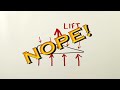
- Lift is an important concept, not only in flying but also in sailing. This week I'm talking to Olympic Sailor, Hunter Lowden. But before I get to the physics of sailing I thought I would explain lift since it's generally poorly understood.
minutephysics http://bit.ly/Muh6CC
1veritasium http://bit.ly/MrupzL
efit30 http://bit.ly/O4CMme
appchat http://bit.ly/NxAMlX
erikaanear http://bit.ly/MdyUzQ
whoisjimmy http://bit.ly/LtFzpW
numberphile http://bit.ly/numberphile
Music by Nathaniel Schroeder
youtube: http://bit.ly/pakJLE
myspace: http://mysp.ac/qtmZQj

- Title
- Veritasium & Team Record Gold Invade London
- Runtime
- 3:20
- Date posted
- 14 years ago
- Description
- I'm going to London! And I'm leading a team of YouTubers. For the next few weeks we will all be doing videos themed around the Olympics so I'm tackling the science of sport and science in and around London.
The Team!
HOWRIDICULOUS: http://bit.ly/LtFzpW
APPCHAT: http://bit.ly/NxAMlX
ERIKAANEAR: http://bit.ly/MdyUzQ
MINUTEPHYSICS: http://bit.ly/Muh6CC
EFIT30: http://bit.ly/O4CMme
2VERITASIUM http://youtube.com/2veritasium
Music by Alankeys86 and Kevin McLeod (Incompetech.com)
For the London 2012 Summer Olympics creators from all over the world are taking over YouTube with the most awesome Olympics videos ever. Go to YouTube.com/CreatorHub to see all the amazing gold medal videos.

- Title
- Atomic Bonding Song
- Runtime
- 4:49
- Date posted
- 14 years ago
- Description
- Starring: Christie Wykes as Chlorine, Carbon, and Sodium
Director of Photography: Sean McCallum
Gravity (John Mayer Cover) http://www.youtube.com/watch?v=u7KpH9_I2Dw
I'm Atoms (Jason Mraz Cover) http://www.youtube.com/watch?v=DBjZz0iQrzI
Electricity (Jet Cover) http://www.youtube.com/watch?v=cY-kiddvAg0
Experiments A Cappella http://www.youtube.com/watch?v=lRbI_vPyOnc

- Title
- Free Higgs!
- Runtime
- 3:20
- Date posted
- 14 years ago
- Description
- To celebrate the announcement of the discovery of a particle consistent with the Higgs Boson at the LHC, I took to the streets with Vi Hart to give out free Higgs. Now giving out a subatomic particle, especially the Higgs, would have been incredibly difficult so instead we gave out hand-drawn cards of the Standard Model, our current best theory of all matter particles in the universe and their iteractions (now with Higgs!). We also offered a hug with an integer spin, usually 1 or 2 (and in rare cases 0). This is a way of showing others that you care about the Higgs Boson.
- Title
- The First Meeting of EDUtubers! ft. CGPGrey, Vsauce, Smarter Every Day, Numberphile +more
- Runtime
- 3:03
- Date posted
- 14 years ago
- Description
- Back in 2012, we all met for the first time at BrainSTEM - a conference of science YouTubers, instigated by Henry of MinutePhysics (Thank You Henry!!!) bringing together the most awesome STEM personalities from around the world. People like Vsauce, John Green, Vihart, Destin from Smarter Every Day, CGP Grey, Brady Haran of Numberphile et al. I had an awesome three days hanging out with all the cool people in this video and hopefully this is only the start of many fruitful collaborations to come. Thanks everyone!!!
Now this happens to be video 100 for me. It's not really about science, but I think it's pretty awesome because it features all of my YouTube heroes.

- Title
- Northern Lights From 100,000 ft!
- Runtime
- 4:47
- Date posted
- 14 years ago
- Description
- In April 2012, I was part of a team of scientists, teachers and students who travelled to Alaska to observe the Northern Lights or Aurora Borealis. Our mission was a unique one - to launch weather balloons up to 100,000 feet loaded with experiments, tracking devices and HD cameras. This is the result of our trip, produced for Catalyst on ABC1 http://www.abc.net.au/catalyst/

- Title
- Does a Falling Slinky Defy Gravity?
- Runtime
- 5:46
- Date posted
- 15 years ago
- Description
- This is how a slinky falls in slow motion - it appears to defy gravity but the centre of mass is accelerating at 9.8m/s^2 meaning the top is accelerating faster than that and the bottom is not falling at all until the entire slinky collapses.
Read a pre-print of the physics paper here: http://arxiv.org/abs/1208.4629
Music by Kevin McLeod http://incompetech.com
Songs: Industrial Music Box, Heavy Interlude, Pale Rider, Decisions.
Slow motion photography courtesy of Questacon http://questacon.edu.au
The original goal of Veritasium was to show the beauty of science and I think the first minute and a half of this is the closest I've come. This is the last in a series of six videos about slinkies.

- Title
- Transit of Venus! Sydney 2012 Contacts, Contracts and Parallax
- Runtime
- 5:58
- Date posted
- 15 years ago
- Description
- Smarter Every Day Collaboration video: http://youtu.be/riwc3UgPaHw
The Veritasium treatment of the final transit of Venus this century. The weather behaved for some key moments allowing me to observe Venus passing across the disk of the sun. The transit of Venus is steeped in historical significance. Observations of the transit in 1769 led to the first really accurate calculation of the Earth-Sun distance (or one astronomical unit AU). Since Cook was in Tahiti he then mapped the East coast of Australia and parts of New Zealand.

- Title
- Spinning Disk Trick Solution
- Runtime
- 4:16
- Date posted
- 15 years ago
- Description
- ZoggFromBetelgeuse's solution: http://www.youtube.com/watch?v=pwl-rBVbWAY
This is a preliminary solution to the spinning disk trick based on the commonly cited tippe top explanation. I have my doubts that it tells the whole story because the disk seems to tilt, so the argument about constant angular velocity is in doubt. I wonder if the weight of the disk plays a more important role in making it flip. Plus, I think the disk appears to roll without slipping while the lighter side is moving down. This violates one of the assumptions of the tippe top explanation. So why am I publishing this now? I feel bad it has been two weeks and I haven't posted the answer yet so let's consider this a starting point for a work in progress...

- Title
- How Does A Slinky Fall?
- Runtime
- 3:51
- Date posted
- 15 years ago
- Description
- Some months a go I filmed a slinky falling in slow motion. Now I have interviewed the public about what they expect to happen for ABC TV's Catalyst program and this is the result.
- Title
- Gyroscopic Precession
- Runtime
- 3:49
- Date posted
- 15 years ago
- Description
- NOTE: This video will appear in a playlist on Smarter Every Day hence the references to Veritasium. Destin does lots of cool science stuff - check out his channel if you haven't already http://www.youtube.com/destinws2
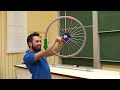
We have been collaborating on rotational motion, which is timely for some of the videos I've been doing lately. In this video I talk about gyroscopic precession - the "wobbling" of a spinning top around its axis.
This is caused by the torque due to the object's weight. The big idea is that the torque vector increases angular momentum in the direction of torque. So if there is no angular momentum initially, it will cause the system to swing in such a direction that it is rotating with new angular momentum in the direction of the torque. However, if there was angular momentum to begin with, the torque will change the direction of that angular momentum by causing precession.

- Title
- Spinning Disk Trick
- Runtime
- 1:51
- Date posted
- 15 years ago
- Description
- Objects hang heavy side down, but what happens when you spin an asymmetrically weighted disk - well the heavy part actually rises to the top. Why is this?

- Title
- Why Are Astronauts Weightless?
- Runtime
- 3:41
- Date posted
- 15 years ago
- Description
- http://www.abc.net.au/catalyst/team/default.htm
I have been working with Catalyst on ABC1 to bring some Veritasium to Australian TV. In this segment I ask why astronauts in the space station are weightless. The most common answer is because there is no gravity in space. But of course there is gravity in space, especially where the space station is located (only about 400km from Earth's surface). So astronauts still experience a gravitational pull - it's just that they and the space station are in free fall so they are accelerating together towards the Earth. The space station doesn't crash into the Earth because of its orbital velocity - it's going 28,000 km/h so as it falls, the Earth curves away from it.

- Title
- Where Does The Sun Get Its Energy?
- Runtime
- 6:01
- Date posted
- 15 years ago
- Description
- The sun has been producing light for about five billion years but where does all its energy come from? The most common idea is that the sun is burning gas - like a giant fireball in the sky. If this were true, the sun would have gone out long ago. So how is the sun actually fuelling itself? It is converting its own mass into energy. By combining protons (the nucleus of hydrogen) into helium, it squeezes some mass into energy - 4.3 billion kg per second. It is Einstein's famous E=mc^2 which gives us the quantitative relationship between mass and energy, where c is the speed of light.

- Title
- What Causes The Northern Lights?
- Runtime
- 4:56
- Date posted
- 15 years ago
- Description
- The aurora borealis or northern lights is one of the most spectacular natural displays on the planet. Theories about its origins have been debated for centuries and common misconceptions persist that the aurora is the sun's rays scattered off ice crystals in the high atmosphere. In truth, the light is created more than 100km above Earth's surface as high speed electrons and protons ejected from the sun in a solar flare or coronal mass ejection collide with air molecules in the upper atmosphere. The charged particles from the sun excite air molecules which then de-excite by emitting light. The display is most common around the north and south poles because the Earth's magnetic field deflects the solar wind from the equator to the poles. Here the magnetic field dips towards the Earth's surface, channeling the charged particles into the atmosphere.
Music is by Kevin MacLeod http://incompetech.com, the song is called Mirage

- Title
- Destination: Alaska
- Runtime
- 4:09
- Date posted
- 15 years ago
- Description
- More about the Alaska Trip: http://education.projectaether.org
Channel 10 Breakfast: http://www.tenbreakfast.com.au (6-9am weekdays in Australia)
March 26 segment on live TV talking about solar storms and my upcoming trip to the Great White North. As you watch this I will probably be on a plane high over the pacific.
PS a student recently told me that my hair to beard ratio is a bit off and watching this clip I tend to agree. However, it is still -20 C at night in Alaska so I'll need all the insulation I can get.